
‘The play’s the thing / Wherein I’ll catch the conscience of the King.’
Contents
- Audio Version of the Scene
- Modern Text Version
- Plot and Character Summary
- Introduction
- Thematic and Structural Precedent: Act 2 Scene 2 in Context
- The Royal Audience: Schemes and Diplomatic Games
- Polonius’s “Method”: The Folly of Certainty
- Hamlet’s Gambit: Deception as a Weapon
- The Arrival of the Players: Performance and Reality
- Conclusion
- How well do you know the scene?
- Interactive Questions
Audio Version of the Scene
Modern Text Version
| Original Text | Modern English |
|---|---|
| Enter KING CLAUDIUS, QUEEN GERTRUDE, ROSENCRANTZ, GUILDENSTERN, and Attendants | King Claudius, Queen Gertrude, Rosencrantz, Guildenstern, and attendants enter. |
| KING CLAUDIUS Welcome, dear Rosencrantz and Guildenstern! Moreover that we much did long to see you, The need we have to use you did provoke Our hasty sending. Something have you heard Of Hamlet's transformation; so call it, Sith nor the exterior nor the inward man Resembles that it was. What it should be, More than his father's death, that thus hath put him So much from the understanding of himself, I cannot dream of: I entreat you both, That, being of so young days brought up with him, And sith so neighbour'd to his youth and havior, That you vouchsafe your rest here in our court Some little time: so by your companies To draw him on to pleasures, and to gather, So much as from occasion you may glean, Whether aught, to us unknown, afflicts him thus, That, open'd, lies within our remedy. | KING CLAUDIUS Welcome, Rosencrantz and Guildenstern! Besides that we really wanted to see you, we urgently needed your help—that’s why we sent for you so quickly. You’ve heard something of Hamlet’s “change”—let’s call it that—since he’s nothing like he used to be, inside or out. I can’t imagine what, beyond his father’s death, has pushed him so far from knowing himself. I’m asking you both—since you grew up with him and know his ways—to stay here at court for a while. Spend time with him, cheer him up, and see if you can find out whether anything (unknown to us) is bothering him—something we could fix if we knew about it. |
| QUEEN GERTRUDE Good gentlemen, he hath much talk'd of you; And sure I am two men there are not living To whom he more adheres. If it will please you To show us so much gentry and good will As to expend your time with us awhile, For the supply and profit of our hope, Your visitation shall receive such thanks As fits a king's remembrance. | QUEEN GERTRUDE Gentlemen, he talks about you a lot. I’m sure there aren’t two people alive he’s more attached to. If you’d be so kind as to spend some time with us—to help our hopes along—you’ll get thanks worthy of a king’s memory. |
| ROSENCRANTZ Both your majesties Might, by the sovereign power you have of us, Put your dread pleasures more into command Than to entreaty. | ROSENCRANTZ Your Majesties could just command us rather than ask—we’re your subjects. |
| GUILDENSTERN But we both obey, And here give up ourselves, in the full bent To lay our service freely at your feet, To be commanded. | GUILDENSTERN We’ll gladly obey. We give ourselves completely to serve you. Tell us what to do. |
| KING CLAUDIUS Thanks, Rosencrantz and gentle Guildenstern. | KING CLAUDIUS Thank you, Rosencrantz—and good Guildenstern. |
| QUEEN GERTRUDE Thanks, Guildenstern and gentle Rosencrantz: And I beseech you instantly to visit My too much changed son. Go, some of you, And bring these gentlemen where Hamlet is. | QUEEN GERTRUDE Thank you, Guildenstern—and dear Rosencrantz. Please go see my son at once—he’s changed so much. Someone, take these gentlemen to Hamlet. |
| GUILDENSTERN Heavens make our presence and our practises Pleasant and helpful to him! | GUILDENSTERN God grant that our company and efforts help him! |
| QUEEN GERTRUDE Ay, amen! Exeunt ROSENCRANTZ, GUILDENSTERN, and some Attendants Enter POLONIUS | QUEEN GERTRUDE Yes—amen! Rosencrantz, Guildenstern, and some attendants exit. Polonius enters. |
| LORD POLONIUS The ambassadors from Norway, my good lord, Are joyfully return'd. | LORD POLONIUS My lord, the ambassadors from Norway are happily back. |
| KING CLAUDIUS Thou still hast been the father of good news. | KING CLAUDIUS You’re always the bringer of good news. |
| LORD POLONIUS Have I, my lord? I assure my good liege, I hold my duty, as I hold my soul, Both to my God and to my gracious king: And I do think, or else this brain of mine Hunts not the trail of policy so sure As it hath used to do, that I have found The very cause of Hamlet's lunacy. | LORD POLONIUS Have I? Well, I serve God and my king with all my soul. And I believe (unless my wits aren’t as sharp as they used to be) that I’ve found the exact cause of Hamlet’s madness. |
| KING CLAUDIUS O, speak of that; that do I long to hear. | KING CLAUDIUS Oh—tell me that. I’m dying to hear it. |
| LORD POLONIUS Give first admittance to the ambassadors; My news shall be the fruit to that great feast. | LORD POLONIUS Let the ambassadors report first; my news can be dessert after that main course. |
| KING CLAUDIUS Thyself do grace to them, and bring them in. Exit POLONIUS He tells me, my dear Gertrude, he hath found The head and source of all your son's distemper. | KING CLAUDIUS Please go welcome them in yourself. Polonius exits. He says, Gertrude, that he’s found the root cause of your son’s disturbance. |
| QUEEN GERTRUDE I doubt it is no other but the main; His father's death, and our o'erhasty marriage. | QUEEN GERTRUDE I think it’s just the obvious: his father’s death and our too-hasty marriage. |
| KING CLAUDIUS Well, we shall sift him. | KING CLAUDIUS We’ll get to the bottom of it. |
| Re-enter POLONIUS, with VOLTIMAND and CORNELIUS KING CLAUDIUS Welcome, my good friends! Say, Voltimand, what from our brother Norway? | Polonius returns with Voltimand and Cornelius. KING CLAUDIUS Welcome, friends! Well, Voltimand—what news from the king of Norway (our “brother”)? |
| VOLTIMAND Most fair return of greetings and desires. Upon our first, he sent out to suppress His nephew's levies; which to him appear'd To be a preparation 'gainst the Polack; But, better look'd into, he truly found It was against your highness: whereat grieved, That so his sickness, age and impotence Was falsely borne in hand, sends out arrests On Fortinbras; which he, in brief, obeys; Receives rebuke from Norway, and in fine Makes vow before his uncle never more To give the assay of arms against your majesty. Whereon old Norway, overcome with joy, Gives him three thousand crowns in annual fee, And his commission to employ those soldiers, So levied as before, against the Polack: With an entreaty, herein further shown, Giving a paper That it might please you to give quiet pass Through your dominions for this enterprise, On such regards of safety and allowance As therein are set down. | VOLTIMAND He sends respectful greetings. At first, he moved to stop his nephew’s army, which he thought was aimed at Poland, but on looking closer he realized it was aimed at you. Upset that people had taken advantage of his illness and age, he had Fortinbras arrested. Fortinbras obeyed, got a scolding, and swore to his uncle never again to attack Your Majesty. Delighted, old Norway gave him a yearly pension of three thousand crowns and permission to use those troops—now against Poland. He also asks (it’s written here) that you allow safe passage through Denmark for this campaign, with the conditions laid out in this letter. |
| KING CLAUDIUS It likes us well; And at our more consider'd time well read, Answer, and think upon this business. Meantime we thank you for your well-took labour: Go to your rest; at night we'll feast together: Most welcome home! Exeunt VOLTIMAND and CORNELIUS | KING CLAUDIUS That sounds good to us. We’ll read this carefully later, respond, and consider it. Meanwhile, thank you for your efforts. Go rest—we’ll feast together tonight. Welcome home! Voltimand and Cornelius exit. |
| LORD POLONIUS This business is well ended. My liege, and madam, to expostulate What majesty should be, what duty is, Why day is day, night night, and time is time, Were nothing but to waste night, day and time. Therefore, since brevity is the soul of wit, And tediousness the limbs and outward flourishes, I will be brief: your noble son is mad: Mad call I it; for, to define true madness, What is't but to be nothing else but mad? But let that go. | LORD POLONIUS That’s all wrapped up nicely. Your Majesties, to explain what “majesty” is, what “duty” is, why day is day and night is night—that would just waste day and night. So, since brevity is the soul of wit (and rambling is just decoration), I’ll be brief: your son is mad. Let’s call it madness; and if we define real madness, what else is it but being mad? Anyway—moving on. |
| QUEEN GERTRUDE More matter, with less art. | QUEEN GERTRUDE More substance, less show. |
| LORD POLONIUS Madam, I swear I use no art at all. That he is mad, 'tis true: 'tis true 'tis pity; And pity 'tis 'tis true: a foolish figure; But farewell it, for I will use no art. Mad let us grant him, then: and now remains That we find out the cause of this effect, Or rather say, the cause of this defect, For this effect defective comes by cause: Thus it remains, and the remainder thus. Perpend. I have a daughter—have while she is mine— Who, in her duty and obedience, mark, Hath given me this: now gather, and surmise. Reads 'To the celestial and my soul's idol, the most beautified Ophelia,'— That's an ill phrase, a vile phrase; 'beautified' is a vile phrase: but you shall hear. Thus: Reads 'In her excellent white bosom, these, & c.' | LORD POLONIUS Madam, I’m not being fancy at all. That he’s mad—true; and it’s a pity—true; and pity it is—true. (Yes, that’s a silly way to say it.) Anyway, no fancy style. Let’s grant he’s mad. What remains is to find the cause of this effect—or rather the cause of this defect (since this defective effect must have a cause). So, here’s the point—pay attention. I have a daughter—as long as she’s mine—who, dutiful and obedient, gave me this. Now listen and figure it out. Reads “To the heavenly and idol of my soul, the most beautified Ophelia”—(that’s a terrible phrase; “beautified” is awful)—but listen: Reads “These to her excellent white bosom, etc.” |
| QUEEN GERTRUDE Came this from Hamlet to her? | QUEEN GERTRUDE Hamlet sent that to her? |
| LORD POLONIUS Good madam, stay awhile; I will be faithful. Reads 'Doubt thou the stars are fire; Doubt that the sun doth move; Doubt truth to be a liar; But never doubt I love. 'O dear Ophelia, I am ill at these numbers; I have not art to reckon my groans: but that I love thee best, O most best, believe it. Adieu. 'Thine evermore most dear lady, whilst this machine is to him, HAMLET.' This, in obedience, hath my daughter shown me, And more above, hath his solicitings, As they fell out by time, by means and place, All given to mine ear. | LORD POLONIUS Please, madam, hold on—I’ll read it exactly. Reads: “Doubt that the stars are fire; Doubt that the sun moves; Doubt the truth itself; But never doubt that I love. Dear Ophelia, I’m bad at poetry; I can’t count my sighs properly; but believe that I love you best, most best. Goodbye. Yours forever, as long as this body is his, HAMLET.” My daughter showed me this, obediently, and she’s told me all about his approaches to her—when, how, and where they happened. |
| KING CLAUDIUS But how hath she Received his love? | KING CLAUDIUS But how did she respond to his love? |
| LORD POLONIUS What do you think of me? | LORD POLONIUS What do you think of me? |
| KING CLAUDIUS As of a man faithful and honourable. | KING CLAUDIUS As honorable and faithful. |
| LORD POLONIUS I would fain prove so. But what might you think, When I had seen this hot love on the wing— As I perceived it, I must tell you that, Before my daughter told me—what might you, Or my dear majesty your queen here, think, If I had play'd the desk or table-book, Or given my heart a winking, mute and dumb, Or look'd upon this love with idle sight; What might you think? No, I went round to work, And my young mistress thus I did bespeak: 'Lord Hamlet is a prince, out of thy star; This must not be:' and then I precepts gave her, That she should lock herself from his resort, Admit no messengers, receive no tokens. Which done, she took the fruits of my advice; And he, repulsed—a short tale to make— Fell into a sadness, then into a fast, Thence to a watch, thence into a weakness, Thence to a lightness, and, by this declension, Into the madness wherein now he raves, And all we mourn for. | LORD POLONIUS I hope I deserve that. But imagine what you would think of me—when I first noticed this passionate love (I saw it myself before my daughter told me)—if I had just written it down like a clerk, winked and kept quiet, or watched it idly. What would you think? No—I acted directly. I told my girl: “Lord Hamlet is a prince—out of your league. This must not be.” Then I gave her strict orders: shut yourself off from him, accept no messages, no gifts. She followed my advice, and he—rejected (to make a long story short)—fell into sadness, then stopped eating, then couldn’t sleep, then grew weak, then light-headed, and by this decline, into the madness he now raves in—and we all grieve for. |
| KING CLAUDIUS Do you think 'tis this? | KING CLAUDIUS Do you really think that’s the cause? |
| QUEEN GERTRUDE It may be, very likely. | QUEEN GERTRUDE It could be—quite likely. |
| LORD POLONIUS Hath there been such a time—I'd fain know that— That I have positively said 'Tis so,' When it proved otherwise? | LORD POLONIUS Has there ever been a time—tell me—when I said “It’s definitely this,” and it turned out not to be? |
| KING CLAUDIUS Not that I know. | KING CLAUDIUS Not that I know of. |
| LORD POLONIUS [Pointing to his head and shoulder] Take this from this, if this be otherwise: If circumstances lead me, I will find Where truth is hid, though it were hid indeed Within the centre. | LORD POLONIUS [Pointing from head to shoulder] You can take my head off if I’m wrong. If the clues lead me, I’ll find the truth—even if it were hidden at the center of the earth. |
| KING CLAUDIUS How may we try it further? | KING CLAUDIUS How do we test this further? |
| LORD POLONIUS You know, sometimes he walks four hours together Here in the lobby. | LORD POLONIUS He often walks for four hours at a time here in the lobby. |
| QUEEN GERTRUDE So he does indeed. | QUEEN GERTRUDE Yes, he does. |
| LORD POLONIUS At such a time I'll loose my daughter to him: Be you and I behind an arras then; Mark the encounter: if he love her not And be not from his reason fall'n thereon, Let me be no assistant for a state, But keep a farm and carters. | LORD POLONIUS When he does, I’ll send my daughter to him. You and I will hide behind a tapestry and watch. If he doesn’t love her—and isn’t mad because of her—then I’m not fit for government; I should go run a farm. |
| KING CLAUDIUS We will try it. | KING CLAUDIUS We’ll try it. |
| QUEEN GERTRUDE But, look, where sadly the poor wretch comes reading. | QUEEN GERTRUDE Look—here he comes, reading, and looking miserable. |
| LORD POLONIUS Away, I do beseech you, both away: I'll board him presently. Exeunt KING CLAUDIUS, QUEEN GERTRUDE, and Attendants. Enter HAMLET, reading O, give me leave: How does my good Lord Hamlet? | LORD POLONIUS Please, both of you, step aside. I’ll engage him now. The King, Queen, and attendants exit. Hamlet enters, reading. Please allow me—How are you, good Lord Hamlet? |
| HAMLET Well, God-a-mercy. | HAMLET Well enough, thanks. |
| LORD POLONIUS Do you know me, my lord? | LORD POLONIUS Do you know who I am, my lord? |
| HAMLET Excellent well; you are a fishmonger. | HAMLET Oh yes—perfectly. You’re a fishmonger. (i.e., pimp—insult) |
| LORD POLONIUS Not I, my lord. | LORD POLONIUS Not me, my lord. |
| HAMLET Then I would you were so honest a man. | HAMLET Then I wish you were at least honest. |
| LORD POLONIUS Honest, my lord! | LORD POLONIUS Honest, my lord? |
| HAMLET Ay, sir; to be honest, as this world goes, is to be one man picked out of ten thousand. | HAMLET Yes. In this world, being honest makes you one in ten thousand. |
| LORD POLONIUS That's very true, my lord. | LORD POLONIUS Very true, my lord. |
| HAMLET For if the sun breed maggots in a dead dog, being a god kissing carrion,—Have you a daughter? | HAMLET The sun even breeds maggots in a dead dog (the “god” kissing rotting flesh)… Do you have a daughter? |
| LORD POLONIUS I have, my lord. | LORD POLONIUS I do, my lord. |
| HAMLET Let her not walk i' the sun: conception is a blessing: but not as your daughter may conceive. Friend, look to 't. | HAMLET Don’t let her walk in the sun: “conception” (getting pregnant / understanding) is a blessing—but not the way your daughter might “conceive.” (Watch her.) |
| LORD POLONIUS [Aside] How say you by that? Still harping on my daughter: yet he knew me not at first; he said I was a fishmonger: he is far gone, far gone: and truly in my youth I suffered much extremity for love; very near this. I'll speak to him again. What do you read, my lord? | LORD POLONIUS [Aside] What do you make of that? Still going on about my daughter—and he didn’t know me at first; called me a fishmonger. He’s really far gone. I myself suffered terribly for love in my youth—almost like this. I’ll try again. What are you reading, my lord? |
| HAMLET Words, words, words. | HAMLET Words. Just words. |
| LORD POLONIUS What is the matter, my lord? | LORD POLONIUS What’s the “matter” (subject), my lord? |
| HAMLET Between who? | HAMLET Between who? (pretending to take “matter” as “argument between people”) |
| LORD POLONIUS I mean, the matter that you read, my lord. | LORD POLONIUS I mean, what are you reading about? |
| HAMLET Slanders, sir: for the satirical rogue says here that old men have grey beards, that their faces are wrinkled, their eyes purging thick amber and plum-tree gum and that they have a plentiful lack of wit, together with most weak hams: all which, sir, though I most powerfully and potently believe, yet I hold it not honesty to have it thus set down, for yourself, sir, should be old as I am, if like a crab you could go backward. | HAMLET Insults, sir. This satirical jerk says old men have gray beards, wrinkled faces, eyes leaking thick gunk, and a huge lack of brains—plus very weak thighs. All of which, sir, I fully believe; but it isn’t polite to write it down like this, since you, sir, would be as young as I am—if you could go backward like a crab. |
| LORD POLONIUS [Aside] Though this be madness, yet there is method in 't. Will you walk out of the air, my lord? | LORD POLONIUS [Aside] He sounds mad, but there’s logic in it. Will you come in out of the air (outside), my lord? |
| HAMLET Into my grave. | HAMLET Into my grave. |
| LORD POLONIUS Indeed, that is out o' the air. Aside How pregnant sometimes his replies are! a happiness that often madness hits on, which reason and sanity could not so prosperously be delivered of. I will leave him, and suddenly contrive the means of meeting between him and my daughter.—My honourable lord, I will most humbly take my leave of you. | LORD POLONIUS True, that would be “out of the air.” Aside Sometimes his answers are so full of meaning! Madness can luck into a sharp remark that clear reason couldn’t deliver so well. I’ll leave him now and quickly arrange a meeting with my daughter. — My honorable lord, I humbly take my leave. |
| HAMLET You cannot, sir, take from me any thing that I will more willingly part withal: except my life, except my life, except my life. | HAMLET You can’t take anything from me I’m happier to part with—except my life, except my life, except my life. |
| LORD POLONIUS Fare you well, my lord. | LORD POLONIUS Farewell, my lord. |
| HAMLET These tedious old fools! | HAMLET These boring old fools! |
| Original Text | Modern English |
|---|---|
| HAMLET These tedious old fools! | HAMLET These boring old fools! |
| Enter ROSENCRANTZ and GUILDENSTERN | Rosencrantz and Guildenstern enter. |
| LORD POLONIUS You go to seek the Lord Hamlet; there he is. | LORD POLONIUS You’re looking for Lord Hamlet—there he is. |
| ROSENCRANTZ [To POLONIUS] God save you, sir! Exit POLONIUS | ROSENCRANTZ [to Polonius] God bless you, sir. Polonius exits. |
| GUILDENSTERN My honoured lord! | GUILDENSTERN My honored lord! |
| ROSENCRANTZ My most dear lord! | ROSENCRANTZ My dearest lord! |
| HAMLET My excellent good friends! How dost thou, Guildenstern? Ah, Rosencrantz! Good lads, how do ye both? | HAMLET My truly good friends! How are you, Guildenstern? Ah, Rosencrantz! Good guys—how are you both? |
| ROSENCRANTZ As the indifferent children of the earth. | ROSENCRANTZ So-so—just average people in this world. |
| GUILDENSTERN Happy, in that we are not over-happy; On fortune’s cap we are not the very button. | GUILDENSTERN Happy—because we’re not too happy. We’re not at the very top of Fortune’s hat (i.e., not super lucky). |
| HAMLET Nor the soles of her shoe? | HAMLET But not stuck to the sole of her shoe either? (i.e., not completely unlucky?) |
| ROSENCRANTZ Neither, my lord. | ROSENCRANTZ Neither, my lord. |
| HAMLET Then you live about her waist, or in the middle of her favours? | HAMLET So you live around her waist—middling in her favor? (i.e., average luck) |
| GUILDENSTERN ’Faith, her privates we. | GUILDENSTERN Honestly, we’re in her “private parts.” (cheeky joke) |
| HAMLET In the secret parts of fortune? O, most true; she is a strumpet. What’s the news? | HAMLET In Fortune’s secret parts? Too true—Fortune’s a prostitute. What’s the news? |
| ROSENCRANTZ None, my lord, but that the world’s grown honest. | ROSENCRANTZ Nothing, my lord—except the world has become honest. |
| HAMLET Then is doomsday near: but your news is not true. Let me question more in particular: what have you, my good friends, deserved at the hands of fortune, that she sends you to prison hither? | HAMLET Then Judgment Day is near—so that can’t be true. Let me ask you something specific: what did you do to Fortune that she sent you to this prison? |
| GUILDENSTERN Prison, my lord! | GUILDENSTERN Prison, my lord? |
| HAMLET Denmark’s a prison. | HAMLET Denmark is a prison. |
| ROSENCRANTZ Then is the world one. | ROSENCRANTZ Then the whole world is a prison. |
| HAMLET A goodly one; in which there are many confines, wards and dungeons, Denmark being one o’ the worst. | HAMLET A big one—with lots of cells and dungeons, and Denmark is one of the worst. |
| ROSENCRANTZ We think not so, my lord. | ROSENCRANTZ We don’t think so, my lord. |
| HAMLET Why, then, ’tis none to you; for there is nothing either good or bad, but thinking makes it so: to me it is a prison. | HAMLET Then it isn’t, for you. Nothing is good or bad except how you think about it. To me, it’s a prison. |
| ROSENCRANTZ Why then, your ambition makes it one; ’tis too narrow for your mind. | ROSENCRANTZ Then it’s your ambition—it’s too small for your big mind. |
| HAMLET O God, I could be bounded in a nut shell and count myself a king of infinite space, were it not that I have bad dreams. | HAMLET Oh God, I could live inside a nutshell and still feel like a king of endless space—if it weren’t for my bad dreams. |
| GUILDENSTERN Which dreams indeed are ambition, for the very substance of the ambitious is merely the shadow of a dream. | GUILDENSTERN Dreams are ambition—ambition is just the shadow of a dream. |
| HAMLET A dream itself is but a shadow. | HAMLET A dream itself is only a shadow. |
| ROSENCRANTZ Truly, and I hold ambition of so airy and light a quality that it is but a shadow’s shadow. | ROSENCRANTZ True—and ambition is so light and airy it’s a shadow of a shadow. |
| HAMLET Then are our beggars bodies, and our monarchs and outstretched heroes the beggars’ shadows. Shall we to the court? for, by my fay, I cannot reason. | HAMLET Then beggars are the real bodies, and kings and heroes are just their shadows. Shall we go to court? Because, honestly, I can’t think straight. |
| ROSENCRANTZ & GUILDENSTERN We’ll wait upon you. | ROSENCRANTZ & GUILDENSTERN We’ll attend you. |
| HAMLET No such matter: I will not sort you with the rest of my servants, for, to speak to you like an honest man, I am most dreadfully attended. But, in the beaten way of friendship, what make you at Elsinore? | HAMLET No, not like servants. Honestly, I’m surrounded by awful attendants. As friends: what are you doing in Elsinore? |
| ROSENCRANTZ To visit you, my lord; no other occasion. | ROSENCRANTZ Just visiting you, my lord. No other reason. |
| HAMLET Beggar that I am, I am even poor in thanks; but I thank you: and sure, dear friends, my thanks are too dear a halfpenny. Were you not sent for? Is it your own inclining? Is it a free visitation? Come, deal justly with me: come, come; nay, speak. | HAMLET I’m such a beggar I’m poor even in gratitude—but thank you. Still, friends, my thanks are a bit “expensive” (i.e., forced). Weren’t you sent for? Is this your idea? A free visit? Be honest—come on—speak. |
| GUILDENSTERN What should we say, my lord? | GUILDENSTERN What should we say, my lord? |
| HAMLET Why, any thing, but to the purpose. You were sent for; and there is a kind of confession in your looks which your modesties have not craft enough to colour: I know the good king and queen have sent for you. | HAMLET Say anything—but tell the truth. You were sent for; your faces confess it, and you’re not good liars. I know the King and Queen sent for you. |
| ROSENCRANTZ To what end, my lord? | ROSENCRANTZ For what purpose, my lord? |
| HAMLET That you must teach me. But let me conjure you, by the rights of our fellowship, by the consonancy of our youth, by the obligation of our ever-preserved love… be even and direct with me, whether you were sent for, or no? | HAMLET You tell me. I beg you—by our friendship, our shared youth, our lasting bond—be straight with me: were you sent for or not? |
| ROSENCRANTZ [Aside to GUILDENSTERN] What say you? | ROSENCRANTZ [aside to Guildenstern] What do we do? |
| HAMLET [Aside] Nay, then, I have an eye of you.—If you love me, hold not off. | HAMLET [aside] Aha, I’ve got you. — If you care about me, don’t hold back. |
| GUILDENSTERN My lord, we were sent for. | GUILDENSTERN My lord, we were sent for. |
| HAMLET I will tell you why; so shall my anticipation prevent your discovery… I have of late—but wherefore I know not—lost all my mirth… this goodly frame, the earth, seems to me a sterile promontory… this majestical roof fretted with golden fire… appears… a foul and pestilent congregation of vapours. What a piece of work is a man! … the paragon of animals! And yet, to me, what is this quintessence of dust? man delights not me: no, nor woman neither, though by your smiling you seem to say so. | HAMLET I’ll tell you why—so I say it before you “discover” it and betray nothing to the King and Queen. Lately—I don’t know why—I’ve lost all joy; I’ve stopped my usual activities. This beautiful earth feels like a barren cliff; the glorious sky, with “golden” sun, seems like nothing but foul, poisonous vapors. What a masterpiece is a human! Noble mind, endless ability, graceful body, angel in action, godlike in thought—the beauty of the world, the best of animals! Yet to me, this “essence of dust” is nothing. People don’t delight me—men or women (despite the look on your faces). |
| ROSENCRANTZ My lord, there was no such stuff in my thoughts. | ROSENCRANTZ My lord, that’s not what I was thinking. |
| HAMLET Why did you laugh then, when I said “man delights not me”? | HAMLET Then why did you laugh when I said people don’t delight me? |
| ROSENCRANTZ To think, my lord, if you delight not in man, what lenten entertainment the players shall receive from you: we coted them on the way; and hither are they coming, to offer you service. | ROSENCRANTZ I thought: if people don’t delight you, the actors will get a “Lent” reception (i.e., thin rations). We passed them on the road—they’re coming here to perform for you. |
| HAMLET He that plays the king shall be welcome… What players are they? | HAMLET The one who plays the king will be welcome… What company is it? |
| ROSENCRANTZ Even those you were wont to take delight in, the tragedians of the city. | ROSENCRANTZ The same city troupe you used to enjoy—the tragedians. |
| HAMLET How chances it they travel? their residence, both in reputation and profit, was better both ways. | HAMLET Why are they touring? They did better staying put—reputation and money. |
| ROSENCRANTZ I think their inhibition comes by the means of the late innovation. | ROSENCRANTZ I think they were “stopped” (restricted) by recent changes. |
| HAMLET Do they hold the same estimation they did when I was in the city? are they so followed? | HAMLET Are they still as popular as when I was in town? |
| ROSENCRANTZ No, indeed, are they not. | ROSENCRANTZ No, not really. |
| HAMLET How comes it? do they grow rusty? | HAMLET How so? Are they getting rusty? |
| ROSENCRANTZ Nay, their endeavour keeps in the wonted pace: but there is, sir, an aery of children… tyrannically clapped for’t… so berattle the common stages… that many wearing rapiers are afraid of goose-quills and dare scarce come thither. | ROSENCRANTZ No, they’re still working hard; but there’s a troupe of child actors… the crowd cheers them wildly… they attack the regular stages so much that swaggering swordsmen are scared of quills (i.e., writers) and hardly dare show up. |
| HAMLET What, are they children? who maintains ’em? how are they escoted? Will they pursue the quality no longer than they can sing?… will they not say afterwards… their writers do them wrong… | HAMLET Kids? Who funds them? How are they paid? Will they stay actors only while their voices last? Later, when they end up as ordinary players (as likely if money runs out), won’t they claim the writers wronged them by making them insult their future selves? |
| ROSENCRANTZ ’Faith, there has been much to do on both sides… no money bid for argument, unless the poet and the player went to cuffs in the question. | ROSENCRANTZ Honestly, both sides have stirred it up. People wouldn’t pay to watch unless poets and players were practically fistfighting about it. |
| HAMLET Is’t possible? | HAMLET Seriously? |
| GUILDENSTERN O, there has been much throwing about of brains. | GUILDENSTERN Oh yes—lots of brain-slinging (arguments). |
| HAMLET Do the boys carry it away? | HAMLET Are the kids winning? |
| ROSENCRANTZ Ay, that they do, my lord; Hercules and his load too. | ROSENCRANTZ Yes—they carry everything (even Hercules and his burden—huge success). |
| Flourish of trumpets within | Trumpets sound offstage. |
| GUILDENSTERN There are the players. | GUILDENSTERN The players are here. |
| HAMLET Gentlemen, you are welcome to Elsinore… You are welcome: but my uncle-father and aunt-mother are deceived. | HAMLET Gentlemen, welcome to Elsinore… You’re welcome. But my uncle-father and aunt-mother are fooled. |
| GUILDENSTERN In what, my dear lord? | GUILDENSTERN Fooled about what, my lord? |
| HAMLET I am but mad north-north-west: when the wind is southerly I know a hawk from a handsaw. | HAMLET I’m only mad “north-north-west.” When the wind’s southerly, I can tell a hawk from a handsaw. (i.e., I’m not as crazy as they think.) |
| Enter POLONIUS | Polonius enters. |
| LORD POLONIUS Well be with you, gentlemen! | LORD POLONIUS Good day to you, gentlemen! |
| HAMLET Hark you, Guildenstern; and you too: at each ear a hearer: that great baby you see there is not yet out of his swaddling-clouts. | HAMLET Listen, Guildenstern—and you too, Rosencrantz, one in each ear: that big baby over there still isn’t out of his diapers. |
| ROSENCRANTZ Happily he’s the second time come to them; for they say an old man is twice a child. | ROSENCRANTZ Maybe he’s back in them—people say old men are children twice. |
| HAMLET I will prophesy he comes to tell me of the players; mark it. You say right, sir: o’ Monday morning; ’twas so indeed. | HAMLET I predict he’s here to tell me about the players—watch. You’re right, sir: Monday morning—it was indeed. (mocking small talk) |
| LORD POLONIUS My lord, I have news to tell you. | LORD POLONIUS My lord, I have news. |
| HAMLET My lord, I have news to tell you. When Roscius was an actor in Rome,— | HAMLET And I have news for you. When Roscius acted in Rome— (teasing) |
| LORD POLONIUS The actors are come hither, my lord. | LORD POLONIUS The actors have arrived, my lord. |
| HAMLET Buz, buz! | HAMLET Buzz, buzz! (i.e., “old news” / gossip noise) |
| LORD POLONIUS Upon mine honour,— | LORD POLONIUS On my honor— |
| HAMLET Then came each actor on his ass,— | HAMLET Then each actor rode in on a donkey— (mock-epic) |
| LORD POLONIUS The best actors in the world, either for tragedy, comedy, history, pastoral… For the law of writ and the liberty, these are the only men. | LORD POLONIUS They’re the best in the world—tragedy, comedy, history, pastoral… For following the rules and knowing when to improvise—no one better. |
| HAMLET O Jephthah, judge of Israel, what a treasure hadst thou! | HAMLET Oh Jephthah, judge of Israel—what a treasure you had! |
| LORD POLONIUS What a treasure had he, my lord? | LORD POLONIUS What treasure did he have, my lord? |
| HAMLET Why, “One fair daughter and no more, The which he loved passing well.” | HAMLET Why, “One lovely daughter, and no more—whom he loved very much.” (quoting a ballad; hinting at Ophelia) |
| LORD POLONIUS [Aside] Still on my daughter. | LORD POLONIUS [aside] Still going on about my daughter. |
| HAMLET Am I not i’ the right, old Jephthah? | HAMLET Am I right, old Jephthah? |
| LORD POLONIUS If you call me Jephthah, my lord, I have a daughter that I love passing well. | LORD POLONIUS If I’m Jephthah, then yes—I have a daughter I love very much. |
| HAMLET Nay, that follows not. | HAMLET That doesn’t necessarily follow. |
| LORD POLONIUS What follows, then, my lord? | LORD POLONIUS Then what follows? |
| HAMLET Why, “As by lot, God wot,” and then, you know, “It came to pass, as most like it was,”— the first row of the pious chanson will show you more; for look, where my abridgement comes. | HAMLET Well, “As by lot, God knows…” and then “It came to pass, as likely it was…”—the first lines of the devout song tell the rest. But look—my “abridgment” (what cuts our talk short) is coming. |
| Enter four or five Players | Four or five Players enter. |
| Original Text | Modern English |
|---|---|
| Enter four or five Players | Four or five Players enter. |
| HAMLET You are welcome, masters; welcome, all. I am glad to see thee well. Welcome, good friends. O, my old friend! thy face is valenced since I saw thee last: comest thou to beard me in Denmark? What, my young lady and mistress! By’r lady, your ladyship is nearer to heaven than when I saw you last, by the altitude of a chopine. Pray God, your voice, like apiece of uncurrent gold, be not cracked within the ring. Masters, you are all welcome. We’ll e’en to’t like French falconers, fly at any thing we see: we’ll have a speech straight: come, give us a taste of your quality; come, a passionate speech. | HAMLET Welcome, sirs—welcome, everyone. I’m happy to see you. Welcome, my friends. Oh, my old friend—your face has grown whiskers (it’s “valenced”) since I last saw you. Have you come to “beard” me in Denmark? And you, my young lady—my mistress! By Our Lady, you’re closer to heaven than before by the height of your platform shoes (chopine). I hope your voice hasn’t “cracked” (like a coin with a cracked ring). Gentlemen, you’re all welcome. Let’s get to it like French falconers—pounce on anything we see. Give us a sample—something passionate. |
| First Player What speech, my lord? | First Player What speech do you want, my lord? |
| HAMLET I heard thee speak me a speech once, but it was never acted; or, if it was, not above once; for the play, I remember, pleased not the million; ’twas caviare to the general: but it was—as I received it, and others, whose judgments in such matters cried in the top of mine—an excellent play, well digested in the scenes, set down with as much modesty as cunning. I remember, one said there were no sallets in the lines to make the matter savoury, nor no matter in the phrase that might indict the author of affectation; but called it an honest method, as wholesome as sweet, and by very much more handsome than fine. One speech in it I chiefly loved: ’twas Aeneas’ tale to Dido; and thereabout of it especially, where he speaks of Priam’s slaughter: if it live in your memory, begin at this line: let me see, let me see— “The rugged Pyrrhus, like the Hyrcanian beast,”— it is not so:—it begins with Pyrrhus:— “The rugged Pyrrhus, he whose sable arms, Black as his purpose, did the night resemble When he lay couched in the ominous horse, Hath now this dread and black complexion smear’d With heraldry more dismal; head to foot Now is he total gules; horridly trick’d With blood of fathers, mothers, daughters, sons, Baked and impasted with the parching streets, That lend a tyrannous and damned light To their lord’s murder: roasted in wrath and fire, And thus o’er-sized with coagulate gore, With eyes like carbuncles, the hellish Pyrrhus Old grandsire Priam seeks.” So, proceed you. | HAMLET I once heard you do a speech—it was never performed, or maybe only once. The crowd (the “million”) didn’t like it; it was “caviar to the general” (too refined for the masses). But I—and others with good taste—thought it excellent: well structured, modestly written but clever. Someone said it had no “salads” (showy garnish) in the lines to make it tasty, and no pretentious phrasing to accuse the author of affectation—just an honest, wholesome, sweet style—more “handsome” than “fancy.” The speech I loved was Aeneas’s tale to Dido—especially the part about Priam’s slaughter. If you remember it, start at—let me see—“The rugged Pyrrhus, like the Hyrcanian beast”—no, that’s wrong; it begins: “The rugged Pyrrhus, whose black armor, as black as his intention, looked like night when he hid in the Trojan Horse, is now smeared all over with even darker ‘heraldry’: head to toe he’s red (gules), horribly decorated with the blood of fathers, mothers, daughters, sons—blood baked onto him by the burning streets that shine a hellish light on their lord’s murder. Roasted by rage and fire, caked with clotted gore, with eyes like glowing gems (carbuncles), the hellish Pyrrhus hunts old Priam.” Okay—go on from there. |
| LORD POLONIUS ’Fore God, my lord, well spoken, with good accent and good discretion. | LORD POLONIUS By God, my lord—well delivered, with good pronunciation and judgment. |
| First Player “Anon he finds him Striking too short at Greeks; his antique sword, Rebellious to his arm, lies where it falls, Repugnant to command: unequal match’d, Pyrrhus at Priam drives; in rage strikes wide; But with the whiff and wind of his fell sword The unnerved father falls. Then senseless Ilium, Seeming to feel this blow, with flaming top Stoops to his base, and with a hideous crash Takes prisoner Pyrrhus’ ear: for, lo! his sword, Which was declining on the milky head Of reverend Priam, seem’d i’ the air to stick: So, as a painted tyrant, Pyrrhus stood, And like a neutral to his will and matter, Did nothing. But, as we often see, against some storm, A silence in the heavens, the rack stand still, The bold winds speechless and the orb below As hush as death, anon the dreadful thunder Doth rend the region, so, after Pyrrhus’ pause, Aroused vengeance sets him new a-work; And never did the Cyclops’ hammers fall On Mars’s armour forged for proof eterne With less remorse than Pyrrhus’ bleeding sword Now falls on Priam. Out, out, thou strumpet, Fortune! All you gods, In general synod ‘take away her power; Break all the spokes and fellies from her wheel, And bowl the round nave down the hill of heaven, As low as to the fiends!” | First Player “Soon he finds Priam. Pyrrhus is swinging short at the Greeks; his old sword disobeys him, drops where it falls, refusing command. Poorly matched, he drives at Priam, slashing wildly; but the mere gust of that deadly sword makes the unstrung old father collapse. Then senseless Troy (Ilium), as if it felt the blow, bows with its flaming top to its base, and with a terrible crash seems to seize Pyrrhus’s attention. Look—his sword, just descending on Priam’s white head, seems to stick in the air. So like a painted tyrant, Pyrrhus freezes—neutral, doing nothing. But as before a storm the heavens fall silent, clouds stand still, bold winds hush, and the world is quiet—then suddenly thunder splits the sky—so after Pyrrhus’s pause, vengeance wakes him up again; and never did Cyclops’ hammers on Mars’s armor (made for eternal proof) strike with less pity than Pyrrhus’s blood-soaked sword now falls on Priam. Out, out, you whore, Fortune! Gods, in full council, strip her power—break every spoke and rim from her wheel and roll the hub down heaven’s hill to hell!” |
| LORD POLONIUS This is too long. | LORD POLONIUS That’s too long. |
| HAMLET It shall to the barber’s, with your beard. Prithee, say on: he’s for a jig or a tale of bawdry, or he sleeps: say on: come to Hecuba. | HAMLET Then let it go to the barber—along with your beard. Go on—if it isn’t a dirty jig or a bawdy story he falls asleep. Go on—get to Hecuba. |
| First Player “But who, O, who had seen the mobled queen—” | First Player “But who—oh, who—could have seen the mobled (muffled, with head covered) queen—” |
| HAMLET “The mobled queen?” | HAMLET “The mobled queen?” (picking at the odd word) |
| LORD POLONIUS That’s good; “mobled queen” is good. | LORD POLONIUS That’s good—“mobled queen” is good. |
| First Player “Run barefoot up and down, threatening the flames With bisson rheum; a clout upon that head Where late the diadem stood, and for a robe, About her lank and all o’er-teemed loins, A blanket, in the alarm of fear caught up; Who this had seen, with tongue in venom steep’d, ‘Gainst Fortune’s state would treason have pronounced: But if the gods themselves did see her then When she saw Pyrrhus make malicious sport In mincing with his sword her husband’s limbs, The instant burst of clamour that she made, Unless things mortal move them not at all, Would have made milch the burning eyes of heaven, And passion in the gods.” | First Player “Hecuba runs barefoot, trying to fight the flames with bisson rheum (blinding tears); a rag on the head where the crown stood, and for a robe around her thin, over-childbearing body, just a blanket grabbed in panic. Anyone who saw this would curse Fortune’s rule with venom. And if the gods themselves saw her when she watched Pyrrhus ‘play’ by hacking up her husband, the cry she let out—unless the gods feel nothing mortal—would have made heaven’s burning eyes run milch (like milk—i.e., weep), and stirred passion in the gods.” |
| LORD POLONIUS Look, whether he has not turned his colour and has tears in’s eyes. Pray you, no more. | LORD POLONIUS Look—his color’s changed and he has tears in his eyes. Please, stop. |
| HAMLET ’Tis well: I’ll have thee speak out the rest soon. Good my lord, will you see the players well bestowed? Do you hear, let them be well used; for they are the abstract and brief chronicles of the time: after your death you were better have a bad epitaph than their ill report while you live. | HAMLET Fine—we’ll have you finish the rest soon. My lord, will you see the players well lodged? Treat them well: they’re the short, sharp chroniclers of our times. Better to have a bad epitaph after you die than a bad review from them while you live. |
| LORD POLONIUS My lord, I will use them according to their desert. | LORD POLONIUS I’ll treat them as they deserve. |
| HAMLET God’s bodykins, man, much better: use every man after his desert, and who should ‘scape whipping? Use them after your own honour and dignity: the less they deserve, the more merit is in your bounty. Take them in. | HAMLET God’s little body, man—better than that! If you treat everyone only as they deserve, who would escape a whipping? Treat them according to your honor and generosity—the less they deserve, the more credit to your kindness. Take them in. |
| LORD POLONIUS Come, sirs. | LORD POLONIUS Come along, gentlemen. |
| Exit POLONIUS with all the Players but the First | Polonius exits with all the Players except the First. |
| HAMLET Dost thou hear me, old friend; can you play the Murder of Gonzago? | HAMLET Listen, old friend—can you perform The Murder of Gonzago? |
| First Player Ay, my lord. | First Player Yes, my lord. |
| HAMLET We’ll ha’t to-morrow night. You could, for a need, study a speech of some dozen or sixteen lines, which I would set down and insert in’t, could you not? | HAMLET We’ll do it tomorrow night. Could you, if needed, learn a speech of about twelve or sixteen lines that I’ll write and add in? |
| First Player Ay, my lord. | First Player Yes, my lord. |
| HAMLET Very well. Follow that lord; and look you mock him not. | HAMLET Good. Follow that lord—and don’t make fun of him. |
| Exit First Player | First Player exits. |
| HAMLET My good friends, I’ll leave you till night: you are welcome to Elsinore. | HAMLET My friends, I’ll see you tonight. Welcome to Elsinore. |
| ROSENCRANTZ Good my lord! | ROSENCRANTZ Thank you, my lord. |
| HAMLET Ay, so, God be wi’ ye; | HAMLET Yes—God be with you. |
| Exeunt ROSENCRANTZ and GUILDENSTERN | Rosencrantz and Guildenstern exit. |
| HAMLET Now I am alone. O, what a rogue and peasant slave am I! Is it not monstrous that this player here, But in a fiction, in a dream of passion, Could force his soul so to his own conceit That from her working all his visage wann’d, Tears in his eyes, distraction in’s aspect, A broken voice, and his whole function suiting With forms to his conceit? and all for nothing! For Hecuba! What’s Hecuba to him, or he to Hecuba, That he should weep for her? What would he do, Had he the motive and the cue for passion That I have? He would drown the stage with tears And cleave the general ear with horrid speech, Make mad the guilty and appal the free, Confound the ignorant, and amaze indeed The very faculties of eyes and ears. Yet I, A dull and muddy-mettled rascal, peak, Like John-a-dreams, unpregnant of my cause, And can say nothing; no, not for a king, Upon whose property and most dear life A damn’d defeat was made. Am I a coward? Who calls me villain? breaks my pate across? Plucks off my beard, and blows it in my face? Tweaks me by the nose? gives me the lie i’ the throat, As deep as to the lungs? who does me this? Ha! ‘Swounds, I should take it: for it cannot be But I am pigeon-liver’d and lack gall To make oppression bitter, or ere this I should have fatted all the region kites With this slave’s offal: bloody, bawdy villain! Remorseless, treacherous, lecherous, kindless villain! O, vengeance! Why, what an ass am I! This is most brave, That I, the son of a dear father murder’d, Prompted to my revenge by heaven and hell, Must, like a whore, unpack my heart with words, And fall a-cursing, like a very drab, A scullion! Fie upon’t! foh! About, my brain! I have heard That guilty creatures sitting at a play Have by the very cunning of the scene Been struck so to the soul that presently They have proclaim’d their malefactions; For murder, though it have no tongue, will speak With most miraculous organ. I’ll have these players Play something like the murder of my father Before mine uncle: I’ll observe his looks; I’ll tent him to the quick: if he but blench, I know my course. The spirit that I have seen May be the devil: and the devil hath power To assume a pleasing shape; yea, and perhaps Out of my weakness and my melancholy, As he is very potent with such spirits, Abuses me to damn me: I’ll have grounds More relative than this: the play’s the thing Wherein I’ll catch the conscience of the king. | HAMLET Now I’m alone. Oh, what a worthless slave I am! Isn’t it crazy that this actor—just pretending, in a dream of passion—can work himself up so that his face goes pale, his eyes fill with tears, his voice breaks, his whole body matches the emotion—and all for nothing but Hecuba? What is Hecuba to him—or he to Hecuba—that he should weep for her? If he had my reasons and my cue for passion, he’d flood the stage with tears, split every ear with terrifying speech, drive the guilty mad and shock the innocent, confuse the ignorant, and astonish eyes and ears. Yet I—dull, muddy-brained coward—mope like a daydreamer, not “pregnant” (i.e., not filled) with my cause, and say nothing—not even for a king whose life and property were damnedly destroyed. Am I a coward? Who calls me “villain,” smashes my head, plucks off my beard and blows it in my face, tweaks my nose, calls me a liar from the throat to the lungs? Who does that to me? Ha! By God, I’d take it—because I must be pigeon-livered (no bile) and lack the “gall” to make oppression bitter—or else by now I’d have fed all the kites (vultures) with this villain’s guts. Bloody, filthy villain! Remorseless, treacherous, lustful, inhuman villain! Oh, revenge!—But what an ass I am! Very noble of me—that I, a son with a murdered father, urged by heaven and hell to revenge, must unpack my heart like a prostitute—just with words—and curse like a scullery maid. Ugh! Disgusting! Come on, brain! I’ve heard that guilty people watching a play can be struck so deep by the clever scene that they confess their crimes. Murder, though it has no tongue, will speak miraculously. I’ll have these actors play something like my father’s murder in front of my uncle; I’ll watch his face closely; I’ll probe him to the quick. If he flinches, I’ll know what to do. The spirit I saw may be the devil—who can take a pleasing shape—and maybe, because I’m weak and depressed (and such spirits are his specialty), he’s tricking me into damnation. I’ll get better evidence than this. The play is the thing where I’ll catch the king’s conscience. |
| Exit | He exits. |
Plot and Character Summary
| Character | Role in Scene | Primary Motivation | Key Actions |
|---|---|---|---|
| Claudius | The Conspirator | To discover the cause of Hamlet’s madness and neutralize any threat to his throne. | Sends Rosencrantz and Guildenstern to spy; accepts Fortinbras’s request to pass through Denmark. |
| Gertrude | The Worried Mother | To understand her son’s distress and aid his recovery, while also protecting her own reputation. | Summons Hamlet’s friends; proposes her own theory about his melancholy. |
| Polonius | The Overconfident Schemer | To prove his intelligence and regain favor with the King by solving the mystery of Hamlet’s madness. | Presents his theory of love-madness; proposes a plan to spy on Hamlet and Ophelia. |
| Rosencrantz & Guildenstern | The False Friends | To obey the King’s command and win royal favor, at the expense of their friendship with Hamlet. | Agree to spy on Hamlet; attempt to question him about his transformation. |
| Hamlet | The Cunning Protagonist | To uncover the truth about his father’s murder, avenge his death, and navigate the treacherous court. | Feigns madness to Polonius; masterfully exposes his friends’ deceit; reveals his genuine despair; devises a plan to use a play to trap the King. |
| Voltemand & Cornelius | The Ambassadors | To deliver diplomatic news from the King of Norway to Claudius. | Report that Fortinbras has been redirected from attacking Denmark to attacking Poland. |
Introduction
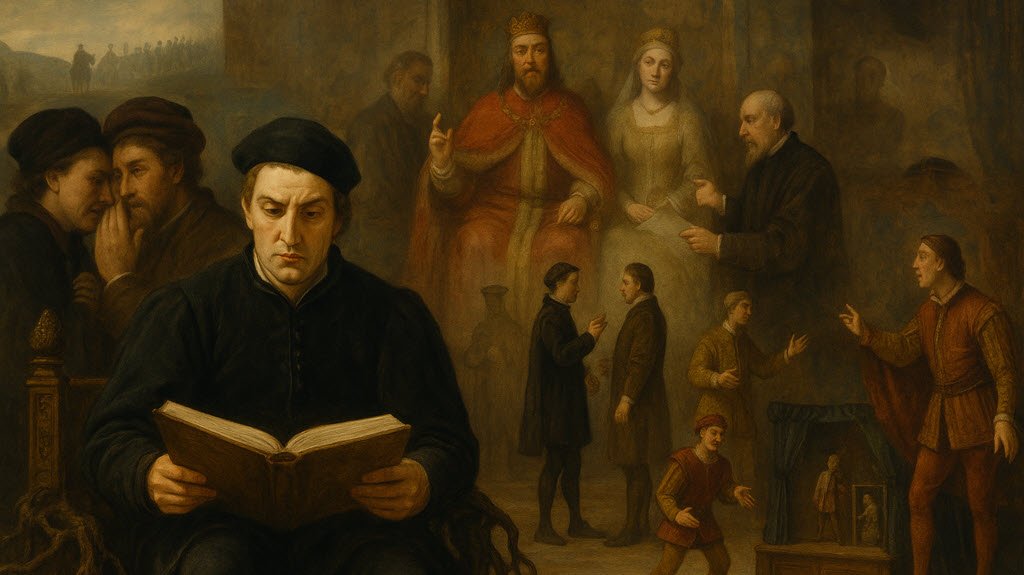
Act 2 Scene 2 is the longest and arguably the most pivotal scene in the play’s rising action. It drives the tragic trajectory by launching intertwined plots built on deception, surveillance, and intellectual manipulation. The scene opens with King Claudius and Queen Gertrude summoning Hamlet’s childhood friends, Rosencrantz and Guildenstern, to spy on him under the guise of concern. This royal subterfuge sets a pattern for the entire court, which is shown to run on schemes and concealed motives. The political machinations are further underscored by the return of ambassadors from Norway, which appears to resolve one external conflict yet introduces a new, lingering threat. Central to the scene is Polonius’s confident proclamation that Hamlet’s “lunacy” springs from unrequited love for Ophelia. His plan to stage a meeting between Hamlet and Ophelia while he and the King listen in exemplifies the culture of surveillance. Within this web of deceit the audience sees Hamlet’s deliberate performance of an “antic disposition.” His cryptic exchanges with Polonius and his exposure of Rosencrantz and Guildenstern’s true purpose reveal a calculating intellect. Yet the scene also offers a raw glimpse of Hamlet’s genuine torment and deep melancholy, especially in “What a piece of work is a man…” The arrival of a company of traveling players becomes both literal and thematic catalyst. In “O, what a rogue and peasant slave am I!” Hamlet pivots from inward despair to a concrete strategy. He resolves to use the theatrical performance to mirror his father’s murder and “catch the conscience of the King.” This marks a crucial turn, as Hamlet moves from philosophical hesitation to cautious, purposeful action. This report examines these dramatic movements and concludes with a 20-question multiple-choice quiz for study and assessment.
Thematic and Structural Precedent: Act 2 Scene 2 in Context
Act 2 Scene 2 is a model of dramatic architecture, a nexus where the play’s central themes converge and accelerate toward the climax. The scene unfolds as escalating acts of deception, revealing a Danish court steeped in moral decay and suspicion. Systemic spying, from the king to the court counselor, creates palpable paranoia. Claudius, driven by guilt and the need to control the narrative around Hamlet, sets a pattern others follow. His use of agents leads to Polonius’s scheme and, ultimately, to Hamlet’s counter-strategy of using a play to uncover the truth. The court performs normalcy while secretly hunting or hiding unwelcome facts, turning Elsinore into a “claustrophobic and corrupt” environment. The scene offers a multi-angled portrait of Hamlet: both cunning strategist and genuinely afflicted son. His “antic disposition” appears in his witty, needling exchange with Polonius, showing a brilliant mind rather than true derangement. This is juxtaposed with the sadness he reveals to his former friends, demonstrating that his distress is real even if his madness is staged. His suspicion of his friends and his decision to use the players to expose Claudius further attest to his strategic acuity. The scene’s strands—the Norway update, Polonius’s theory, Hamlet’s designs—converge to depict a court defined by intrigue, manipulation, and moral ambiguity. The Fortinbras parallel is telling: both are sons of dead kings whose uncles rule, yet Fortinbras’s decisiveness contrasts with Hamlet’s philosophical delay, highlighting Hamlet’s internal conflict and self-reproach. That Fortinbras is redirected by his uncle shows political control and tact that Claudius also wields. Claudius’s assent to the army’s passage is a calculated gamble, implying short-term success in averting an external threat while a greater internal one—Hamlet—intensifies.
The Royal Audience: Schemes and Diplomatic Games
The scene opens with a warm welcome from Claudius and Gertrude to Rosencrantz and Guildenstern. Claudius uses affectionate language, saying he and the Queen “much did long to see you” and that “the need we have to use you did provoke / Our hasty sending.” They ask the pair to “draw him on to pleasures” and to discover “Whether aught, to us unknown, afflicts him thus.” On the surface this sounds like concern for Hamlet’s well-being. Rosencrantz’s reply quickly exposes the nature of the task. He says the majesties “might, by the sovereign power you have of us, / Put your dread pleasures more into command / Than to entreaty.” Their “But we both obey” reveals the coercive reality behind the polite “entreaty.” The Queen’s remark that Hamlet “hath much talk’d of you” and that there are “two men… to whom he more adheres” sets up a quiet betrayal. Their swift agreement to spy, followed by their evasion with Hamlet, shows that a hoped-for “king’s remembrance” outweighs friendship. This choice corrupts their bond with Hamlet and illustrates how power reshapes loyalty. Dramatic irony operates throughout: the audience knows their true mission while Hamlet must infer it. Diplomatically, the ambassadors Voltemand and Cornelius report that “old Norway” has rebuked Fortinbras for his planned assault on Denmark, that Fortinbras has sworn “never more / To give th’ assay of arms against your majesty,” and that he now seeks “quiet pass” through Denmark to attack the Poles. This subplot is an essential thematic parallel. Like Hamlet, Fortinbras is a son confronting a usurping uncle, but he acts decisively, in stark contrast to Hamlet’s hesitation. Claudius’s consent is a strategic risk that appears to neutralize an external danger while internal tensions grow.
Polonius’s “Method”: The Folly of Certainty
After the ambassadors depart, Polonius arrives to announce the cause of Hamlet’s madness. He prefaces his display with the famous “brevity is the soul of wit,” which he promptly contradicts with a long speech. With complete confidence he asserts that Hamlet’s “lunacy” stems from Ophelia’s rejection, calling it the “very ecstasy of love,” and producing a love letter that Ophelia, “in her duty and obedience,” has handed over. Polonius claims he has found “The head and source of all your son’s distemper,” an act of intellectual overreach that reduces a complex psyche to a simple chain of causation. Queen Gertrude offers a more perceptive account: “I doubt it is no other but the main: / His father’s death and our o’erhasty marriage.” Although this implicates herself and Claudius, Polonius sidelines it. The court prefers convenient narratives it can manage to uncomfortable truths it must face. To prove his theory, Polonius proposes surveillance, which Claudius accepts. Hamlet and Ophelia will meet while they “hide behind an arras” to “mark the encounter.” Polonius stakes his standing on the result: “If he love her not… Let me be no assistant for a state, / But keep a farm and carters.” The plan exemplifies the court’s reliance on deception and entrapment and helps explain Hamlet’s immediate suspicion and his subsequent feigned madness during their later exchange.
Hamlet’s Gambit: Deception as a Weapon
Hamlet enters, and the Queen remarks how “sadly” the “poor wretch comes reading.” Eager to test his theory, Polonius approaches. Hamlet’s “antic disposition” becomes a defensive art. He calls Polonius a “fishmonger,” an edged joke that hints at using Ophelia as a pawn. His warning to let Ophelia “not walk i’ the sun” and other riddling remarks are coded critiques of Polonius’s manipulation. Polonius, in turn, concedes the famous irony: “Though this be madness, yet there is method in ’t.” The exchange confirms that Hamlet’s seeming incoherence is strategic. With Rosencrantz and Guildenstern, the tone shifts. Hamlet is initially pleased, then quickly detects deceit and gets them to admit they “were sent for.” What follows contrasts performance with confession. Where Polonius meets jest and riddles, the friends hear unguarded sorrow. Hamlet describes a “foul and pestilent congregation of vapours” and humanity as the “quintessence of dust,” even while calling mankind the “paragon of animals” and “noble in reason.” The speech “What a piece of work is a man…” sets the grandeur of human capacity against Hamlet’s bleak view of it as mere “dust.” This is no act; it is grief and disenchantment.
The Arrival of the Players: Performance and Reality
The traveling players arrive, shifting Hamlet’s mood from weariness to focused energy. The actors set up the theme that art can expose truth, foreshadowed by Hamlet’s own performative strategy.
After welcoming them and requesting the speech about Priam and Hecuba, Hamlet is left alone. In “O, what a rogue and peasant slave am I!” he castigates himself as “rogue and peasant slave,” “coward,” and “villain,” frustrated that the First Player can summon tears for Hecuba while he has not acted on his far greater cause. This frustration becomes catalyst rather than paralysis.
This final soliloquy is the decisive hinge. Hamlet moves from contemplation to plan. His envy is not merely about passion but about art’s capacity to reveal what reality conceals. He will have the players perform The Murder of Gonzago, adding a “short speech” of his own, to reenact his father’s murder. He will watch Claudius closely, hoping thereby to “catch the conscience of the King.” Self-reproach thus yields an ingenious tactic that weaponizes performance to test guilt.
Conclusion
How well do you know the scene?
The following questions are designed to ensure a thorough understanding of every plot element and significant detail within the scene. Each question has been carefully constructed to assess knowledge of character, plot, setting, and thematic concerns, with a limit of three choices.
Interactive Questions
Select your answers, then click Submit to see feedback and your score.
Contents
- Audio Version of the Scene
- Modern Text Version
- Plot and Character Summary
- Introduction
- Thematic and Structural Precedent: Act 2 Scene 2 in Context
- The Royal Audience: Schemes and Diplomatic Games
- Polonius’s “Method”: The Folly of Certainty
- Hamlet’s Gambit: Deception as a Weapon
- The Arrival of the Players: Performance and Reality
- Conclusion
- How well do you know the scene?
- Interactive Questions