
Spies to Paris, Panic at Home: Polonius Reads Hamlet’s “Madness”
Contents
Audio Version of the Scene
Modern Text Version
Hamlet – Act 2, Scene 1
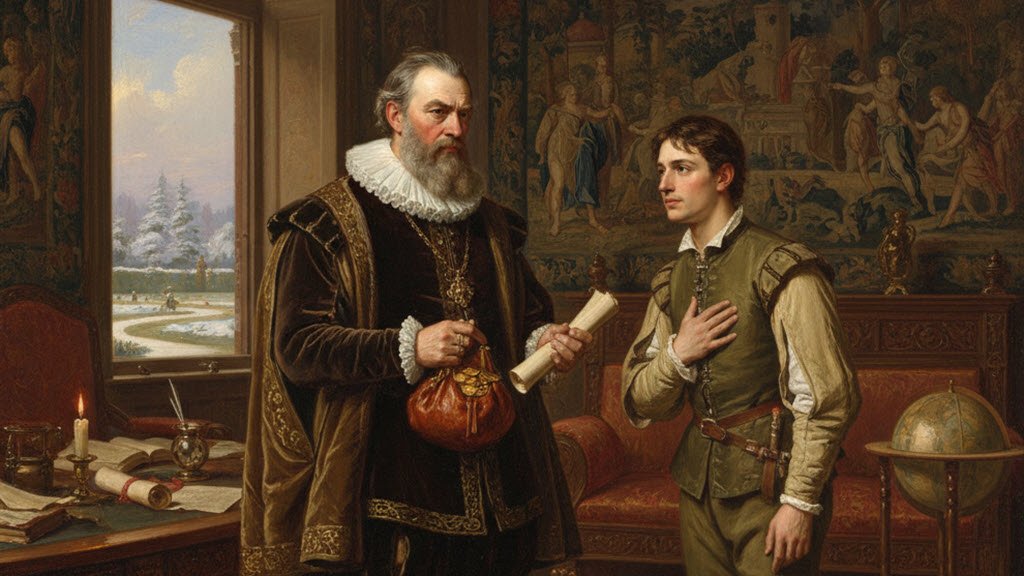
A room in Polonius’s house
| Original Text | Modern English |
|---|---|
| Polonius: Give him this money and these notes, Reynaldo. | Polonius: Take this money and these letters to him, Reynaldo. |
| Reynaldo: I will, my lord. | Reynaldo: Yes, my lord. |
| Polonius: You shall do marvellous wisely, good Reynaldo, Before you visit him, to make inquiry Of his behaviour. | Polonius: You’ll be very clever, Reynaldo, if you check up on how he’s behaving before you go see him. |
| Reynaldo: My lord, I did intend it. | Reynaldo: That was my plan, my lord. |
| Polonius: Marry, well said, very well said. Look you, sir, Enquire me first what Danskers are in Paris; And how, and who, what means, and where they keep, What company, at what expense; and finding By this encompassment and drift of question That they do know my son, come you more nearer Than your particular demands will touch it. | Polonius: Good, that’s well said. Now listen: first ask which Danish people are in Paris, and find out how they live — where they stay, who their friends are, what they spend. Then, by steering your questions in that direction, if they happen to know my son, you’ll learn more than if you just asked directly. |
| Reynaldo: My lord, I’ll do it. | Reynaldo: I’ll do that, my lord. |
| Polonius: And then, sir, does he this—he does—what was I about to say? By the mass, I was about to say something—where did I leave? | Polonius: And then, sir, you should… he does… wait, what was I about to say? By God, I’ve forgotten—where was I? |
| Reynaldo: At “closes in the consequence”—ay, marry. | Reynaldo: You were saying, “leading to the result”… yes, that’s it. |
| Polonius: At “closes in the consequence”—ay, marry; He closes with you thus: “I know the gentleman, I saw him yesterday, or t’other day, Or then, or then; with such or such; and, as you say, There was he gaming, there o’ertook in’s rouse, There falling out at tennis”; or, perchance, “I saw him enter such a house of sale”— Videlicet, a brothel—or so forth. See you now, Your bait of falsehood takes this carp of truth; And thus do we of wisdom and of reach, With windlasses and with assays of bias, By indirections find directions out: So, by my former lecture and advice, Shall you my son. You have me, have you not? | Polonius: Yes, yes, exactly. Then the person will say something like, “I know that young man, I saw him yesterday or the day before, with so-and-so. Yes, he was gambling, or he was drunk, or he got into a fight while playing tennis.” Or maybe, “I saw him going into a certain kind of shop” — meaning a brothel. You see? By planting little lies, you can hook the truth. That’s how wise men discover things — by going around the point instead of straight at it, we find out the truth through hints and tricks. So, that’s how I want you to find out about my son. Do you understand? |
| Reynaldo: My lord, I understand. | Reynaldo: Yes, I understand, my lord. |
| Polonius: Good, very well, very well noted. Look you, sir, Inquire me first what Danskers are in Paris; And how, and who, what means, and where they keep, What company, at what expense; and finding By this encompassment and drift of question That they do know my son, come you more nearer Than your particular demands will touch it. | Polonius: Good, very good. Just to repeat — ask which Danes are in Paris, how they live, where they stay, what company they keep, how much they spend. Then, by this indirect way of questioning, you’ll find out about my son more easily than if you just asked about him directly. |
| Reynaldo: Ay, very well, my lord. | Reynaldo: Yes, very well, my lord. |
| Polonius: And then, sir, does he this—he does—what was I about to say? By the mass, I was about to say something—where did I leave? | Polonius: And then, sir, he does this… wait, what was I saying again? By God, I lost my thought. Where was I? |
| Reynaldo: At “closes in the consequence”—ay, marry. | Reynaldo: You were saying, “leading to the result”… yes, that was it. |
| Polonius: At “closes in the consequence”—ay, marry; He closes with you thus: “I know the gentleman, I saw him yesterday…” | Polonius: Yes, yes — so the person will reply with something like, “I know that man, I saw him yesterday…” |
| Reynaldo: I’ll warrant you, my lord. | Reynaldo: I’ll make sure of it, my lord. |
| Polonius: And then, sir, does he this—he does—what was I about to say? By the mass, I was about to say something—where did I leave? | Polonius: And then, sir, he does this… oh, what was I saying? By God, I had a thought — where did I stop? |
| Reynaldo: At “closes in the consequence.” | Reynaldo: You stopped at “leading to the result.” |
| Polonius: At “closes in the consequence”—ay, marry; He closes with you thus: “I know the gentleman…” | Polonius: Yes, yes. Then the man will say something like: “I know the young man…” |
| Reynaldo: I’ll warrant you, my lord. | Reynaldo: Don’t worry, my lord, I’ll handle it. |
| Polonius: And then, sir, does he this—he does—what was I about to say? | Polonius: And then, sir, he does this… what was I going to say? |
| Reynaldo: At “closes in the consequence.” | Reynaldo: At “leading to the result.” |
| Polonius: At “closes in the consequence”—ay, marry; He closes with you thus: “I know the gentleman…” | Polonius: Yes, yes — then the man answers: “I know him…” |
| [Enter Ophelia] | [Ophelia enters] |
| Polonius: How now, Ophelia? What’s the matter? | Polonius: What is it, Ophelia? What’s wrong? |
| Ophelia: O, my lord, my lord, I have been so affrighted! | Ophelia: Oh, my lord, I’ve been so terrified! |
| Polonius: With what, i’ the name of God? | Polonius: What’s happened, in God’s name? |
| Ophelia: My lord, as I was sewing in my closet, Lord Hamlet, with his doublet all unbraced; No hat upon his head; his stockings fouled, Ungartered, and down-gyved to his ankle; Pale as his shirt; his knees knocking each other; And with a look so piteous in purport As if he had been loosed out of hell To speak of horrors—he comes before me. | Ophelia: My lord, as I was sewing in my room, Hamlet came in. His jacket was undone, he had no hat, his stockings were dirty, loose, and hanging around his ankles. He was pale as his shirt, his knees were knocking together, and he looked so pitiful and dreadful, like he’d come out of hell to tell of horrors. That’s how he appeared to me. |
| Polonius: Mad for thy love? | Polonius: He’s gone mad with love for you? |
| Ophelia: My lord, I do not know, But truly I do fear it. | Ophelia: My lord, I don’t know, but I’m really afraid so. |
| Polonius: What said he? | Polonius: What did he say? |
| Ophelia: He took me by the wrist and held me hard; Then goes he to the length of all his arm; And, with his other hand thus o’er his brow, He falls to such perusal of my face As he would draw it. Long stayed he so; At last, a little shaking of mine arm, And thrice his head thus waving up and down, He raised a sigh so piteous and profound As it did seem to shatter all his bulk And end his being: that done, he lets me go: And, with his head over his shoulder turn’d, He seem’d to find his way without his eyes; For out o’ doors he went without their helps, And, to the last, bended their light on me. | Ophelia: He grabbed me by the wrist and held me tightly, then stepped back at arm’s length. He put his other hand above his eyes like this [shades brow], and stared at my face as though he wanted to draw it. He stayed like that for a long time. Then he shook my arm a little, nodded his head three times, and let out a sigh so deep and painful that it seemed to break his body and soul. Then he let me go, turned his head back as he left, and walked out without even looking where he was going. But until the last moment, his eyes stayed fixed on me. |
| Polonius: Come, go with me: I will go seek the king. This is the very ecstasy of love, Whose violent property fordoes itself And leads the will to desperate undertakings As oft as any passion under heaven That does afflict our natures. I am sorry. What, have you given him any hard words of late? | Polonius: Come with me — I’ll go see the King. This is pure madness from love. Love is so violent that it destroys itself and drives people to desperate actions, just like any strong passion does. I’m sorry… Tell me, have you been harsh with him recently? |
| Ophelia: No, my good lord, but, as you did command, I did repel his letters and denied His access to me. | Ophelia: No, my lord, but as you told me, I rejected his letters and refused to see him. |
| Polonius: That hath made him mad. I am sorry that with better heed and judgment I had not quoted him: I feared he did but trifle And meant to wreck thee; but, beshrew my jealousy! By heaven, it is as proper to our age To cast beyond ourselves in our opinions As it is common for the younger sort To lack discretion. Come, go we to the king: This must be known; which, being kept close, might move More grief to hide than hate to utter love. | Polonius: That’s what’s driven him mad. I regret not judging the situation more wisely. I thought he was only playing with you and would ruin you. Damn my jealousy! By heaven, it’s natural for old men like me to overthink, just as it’s natural for the young to lack judgment. Come, we must tell the King. Keeping this secret could cause more damage than admitting Hamlet loves you. |
| [Exeunt] | [They exit] |
Plot and Character Summary
| Character | Role in Scene | Primary Motivation | Key Actions |
|---|---|---|---|
| Polonius | The Meddling Father | To manage appearances and control his children. | Sends Reynaldo to spy on Laertes in Paris; instructs him to spread indirect rumors; concludes Hamlet is love-mad after Ophelia’s report. |
| Reynaldo | The Discreet Agent | To carry out Polonius’s surveillance scheme. | Agrees to observe Laertes and subtly probe his behavior. |
| Ophelia | The Distressed Daughter | To report Hamlet’s alarming behavior and seek guidance. | Describes Hamlet’s disheveled visit; obeys Polonius’s command to avoid Hamlet. |
Introductory Notes – The Scene as a Microcosm of a Rotten Denmark
Context and Dramatic Placement
Act 2, Scene 1 of Hamlet holds a critical position in the play’s developing arc. The scene occurs “some weeks” after Act 1, when Hamlet has encountered his father’s Ghost. The Ghost’s revelation of murder by Claudius and his demand for revenge lead Hamlet to vow to adopt an antic disposition, a show of madness to conceal his purpose. Although Hamlet does not appear on stage here, his earlier decisions and their repercussions drive the action. The scene fixes the court of Elsinore in an atmosphere of paranoia and deceit. It is not a mere transition; it functions as the structural and thematic fulcrum of Act 2, exposing how an apparently healthy society is corrupt at its core.
The Scene’s Purpose
This scene condenses the play’s central concerns. Themes of spying, mistrust, and appearance versus reality first surface on a domestic scale before intensifying in the political sphere. The opening exchange between Polonius and his servant, Reynaldo, establishes a pattern of institutionalized surveillance and deception. The second movement, marked by Ophelia’s sudden and anxious entry, offers the first external confirmation, though a flawed and misread one, of Hamlet’s supposed madness. Acting on this report, a self-serving Polonius triggers a chain of misjudgments and escalating conflicts that will shape the destinies of the main characters and the state of Denmark. The scene solidifies the atmosphere of corruption and surveillance that infects the court of Elsinore. The opening conversation between Polonius and Reynaldo is a study in “indirections,” revealing Polonius’s reliance on manipulative and deceitful methods to gain information. However, this scene also highlights Polonius’s tragic misdirection. He confidently misinterprets Hamlet’s actions, believing his madness is due to unrequited love for Ophelia, when in fact it is a calculated act to serve his revenge. This fundamental misunderstanding establishes the central conflict between appearance and reality, which becomes a key element of the play’s tragedy. Polonius’s failure to understand the complex reality of Hamlet’s state and his reliance on a simplistic, ego-driven conclusion ensures that the tragedy will unfold. He is the catalyst who takes a private, internal struggle and makes it a public, political issue.
The Polonius–Reynaldo Espionage
Plot Summary
In Polonius’s house at Elsinore, the counselor gives Reynaldo money and notes to deliver to Laertes in Paris, a pretext for a more troubling task. Before seeing Laertes, Reynaldo must make inquire Of his behavior. Polonius orders an indirect method, beginning broadly with questions about Danskers in Paris, then to come you more nearer by claiming only distant acquaintance with Laertes. The core of Polonius’s scheme is to put on him What forgeries you please, suggesting small slips, the wanton, wild and usual habits of youth, such as gaming, drinking, or visiting a house of sale. These slight sullies will serve as a bait of falsehood to catch a carp of truth. Reynaldo hesitates that such talk would dishonour him, but Polonius dismisses the concern as the taints of liberty common to young men.
A Nuanced Character Study of Polonius
This exchange sharpens our view of Polonius, a figure often read in contradictory ways. He appears self-important and pompous, convinced of his judgment, and willing to spy on his own son, revealing a devious, suspicious temperament. He meddles and controls, valuing information and manipulation over his children’s welfare. Yet details of his plan and his meandering delivery can mark him as a comic blunderer. His digressions and brief lapses of memory suggest pedantry and age, undercutting his self-image as a master strategist.
Deeper Insights: The Duality of Polonius and the Theme of Trust
Polonius’s reliance on a bait of falsehood exposes the limits of his intelligence. He boasts of his fetch of wit, yet the scheme is counterproductive. He is ready to spread false rumors about his son, risking Laertes’s reputation to satisfy parental suspicion. The approach is theatrical rather than effective, and it foreshadows his later attempt to spy on Hamlet, which leads to his death. The scene also reflects the wider corrosion of trust in Elsinore. Fractured confidence between father and son mirrors the court’s political tensions. Polonius’s use of Reynaldo anticipates Claudius’s enlistment of Rosencrantz and Guildenstern to watch Hamlet, and it anticipates Polonius’s own fatal eavesdropping behind the arras. Domestic distrust becomes a sign of the rotten Danish state.
| Plotting Target | Method of Spying | Polonius’s Motivation | Dramatic Outcome |
|---|---|---|---|
| Laertes | Reynaldo’s “bait of falsehood” and “assays of bias.” | Parental mistrust and the need for control over his son’s reputation and behavior. | Reynaldo’s success or failure is unknown; the plot mainly showcases Polonius’s character. |
| Hamlet | Using his daughter, Ophelia, as “bait” to draw out Hamlet’s true feelings. | Prove his theory that Hamlet is lovesick and gain political advantage by aligning his family with the Prince. | Leads directly to the confrontational “nunnery scene,” Polonius’s death, and Ophelia’s madness. |
The Polonius–Ophelia Misjudgment
Plot Summary
As Reynaldo exits, Ophelia enters, visibly affrighted. She reports that Hamlet burst into her room while she was sewing and describes his unsettling appearance: his clothes in disarray, his doublet unbraced, his stockings ungartered, and down-gyved to his ankle. He was pale as his shirt, his knees knocking each other, and he wore a look so piteous as if loosed out of hell. His behavior was equally disturbing. He seized her by the wrist and held her hard, staring at her face as he would draw it. After a long silence, he raised a sigh so piteous and profound As it did seem to shatter all his bulk, then let her go and backed out with his eyes to the last bended their light on me. Ophelia confirms that she has obeyed Polonius’s earlier command to repel his letters and denied His access to me.
The Plight of Ophelia and the Ambiguity of Hamlet
Ophelia’s account provides the first reported evidence of Hamlet’s madness. Her fear and detailed narrative emphasize her distress and her position as a pawn between her father’s hard words and Hamlet’s baffling conduct. Because the scene reaches us through Ophelia’s narration, the audience must question the nature of Hamlet’s disorder, and uncertainty becomes the dominant effect.
Deeper Insights: Dramatic Irony and a Fatal Misinterpretation
Dramatic irony saturates the episode. The audience knows that Hamlet intends to feign an antic disposition and has learned the Ghost’s terrifying secrets. Ophelia and Polonius remain unaware. Their ignorance makes their conclusions both pitiable and darkly comic. Ophelia’s image of Hamlet as if loosed out of hell links his behavior to the unseen supernatural encounter that she cannot know. The question persists: is the madness real or performed? Polonius hears Ophelia and declares, This is the very ecstasy of love, and, That hath made him mad. This is not a minor slip but a decisive misreading, rooted in vanity and the urge to be right. Believing he has solved the riddle, he moves to involve the King, treating Hamlet’s condition as proof of his own insight. The choice sets a tragic sequence in motion, including using Ophelia in the nunnery scene, his own death, and Ophelia’s collapse and drowning. Polonius boasts, By indirections find directions out, yet his misdirection ruins him and harms his children. The scene anticipates the full tragic cost of his meddling.
The Scene’s Lasting Impact
Act 2, Scene 1 is not a peripheral scene; it is the fundamental starting point of the play’s tragic conclusion. The scene initiates a cycle of spying, deception, and misjudgment, setting the stage for the catastrophic misunderstandings and inevitable deaths that follow. Polonius’s confident and self-serving declaration that Hamlet is mad for love serves as a dramatic fulcrum, shifting the conflict from a private, internal struggle within Hamlet to a public, inescapable confrontation with Claudius and the entire court. Polonius believes his “indirections find directions out,” but his misguided “directions” will lead to his own ruin and the tragic end of his family. The scene, therefore, is a vital foundation for understanding the play’s descent into chaos, highlighting how a domestic misunderstanding can have lethal consequences in a court already poisoned by deceit.
How well do you know the scene?
The following questions are designed to ensure a thorough understanding of every plot element and significant detail within the scene. Each question has been carefully constructed to assess knowledge of character, plot, setting, and thematic concerns, with a limit of three choices.
Interactive Questions — Polonius, Reynaldo & Ophelia
Select your answers, then click Submit to see feedback and your score.