
Where Spirits Walk and Mortals Tremble
Contents
- Audio Version of the Scene
- Modern Text Version
- Introductory Notes
- The “Vicious Mole of Nature” Speech: A Philosophical and Political Reflection
- The Ghost’s “Questionable Shape”: Supernatural Ambiguity and Moral Uncertainty
- Character Dynamics: Impulse, Reason, and Foreshadowed Madness
- A Diseased Body: From Private Vice to National Corruption
- How well do you know the scene?
- Answers
Audio Version of the Scene
Modern Text Version
Hamlet – Act 1, Scene 4
The platform before the castle. A cold, bitter night.
| Original Text | Modern English |
|---|---|
| Enter HAMLET, HORATIO, and MARCELLUS. | [Hamlet, Horatio, and Marcellus enter.] |
| HAMLET: The air bites shrewdly; it is very cold. | The air is sharp; it’s very cold. |
| HORATIO: It is a nipping and an eager air. | It’s a biting and bitter air. |
| HAMLET: What hour now? | What time is it? |
| HORATIO: I think it lacks of twelve. | I think it’s almost midnight. |
| MARCELLUS: No, it is struck. | No, the clock has struck. |
| HORATIO: Indeed? I heard it not. It then draws near the season Wherein the spirit held his wont to walk. | Really? I didn’t hear it. It’s almost the time when the ghost usually appears. |
| [A flourish of trumpets and two pieces go off.] | [A flourish of trumpets sounds and two cannon shots are heard.] |
| What does this mean, my lord? | What’s the meaning of this, my lord? |
| HAMLET: The king doth wake tonight and takes his rouse, Keeps wassail, and the swaggering up-spring reels; And, as he drains his draughts of Rhenish down, The kettle-drum and trumpet thus bray out The triumph of his pledge. | The king is up late tonight, having a wild party. He’s drinking and dancing loudly. And as he chugs down his wine, the kettle drums and trumpets play to celebrate his toast. |
| HORATIO: Is it a custom? | Is that a tradition? |
| HAMLET: Ay, marry, is’t. But to my mind, though I am native here And to the manner born, it is a custom More honour’d in the breach than the observance. | Yes, it certainly is. But in my opinion, even though I was born and raised here, it’s a custom that would be better if it were ignored than followed. |
| This heavy-headed revel east and west Makes us traduced and tax’d of other nations; They clepe us drunkards, and with swinish phrase Soil our addition; and indeed it takes From our achievements, though perform’d at height, The pith and marrow of our attribute. | This loud, drunken partying makes us criticized and judged by other countries. They call us drunkards and insult our reputation with terms like “swine.” And this behavior takes away from the credit we get for our accomplishments, no matter how great they are. |
| So, oft it chances in particular men, That for some vicious mole of nature in them, As, in their birth,—wherein they are not guilty, Since nature cannot choose his origin,—By their o’ergrowth of some complexion, Oft breaking down the pales and forts of reason, Or by some habit that too much o’erleavens The form of plausive manners,—that these men, Carrying, I say, the stamp of one defect, Being Nature’s livery, or Fortune’s star,—Their virtues else (be they as pure as grace, As infinite as man may undergo) Shall in the general censure take corruption From that particular fault. The dram of eale Doth all the noble substance of a doubt To his own scandal. | It’s often the same with people: for some small flaw in their character, something they were born with—which isn’t their fault, since they can’t choose where they come from—or some personal trait that overpowers their reason, or some bad habit that spoils their pleasant manners, these people—who are marked by this one defect, whether from nature or bad luck—will have all their other good qualities, even if they’re as pure as grace itself, be stained and criticized because of that single flaw. One small drop of evil can ruin a great and noble reputation. |
| Enter GHOST. | [The Ghost enters.] |
| HORATIO: Look, my lord, it comes! | Look, my lord, it’s here! |
| HAMLET: Angels and ministers of grace defend us! Be thou a spirit of health or goblin damn’d, Bring with thee airs from heaven or blasts from hell, Be thy intents wicked or charitable, Thou com’st in such a questionable shape That I will speak to thee. | May angels and powers of grace protect us! Whether you are a good spirit or a damned goblin, whether you bring heavenly grace or hellish curses, whether your purpose is evil or good, you appear in such a puzzling form that I must speak to you. |
| I’ll call thee Hamlet, King, father, royal Dane: O, answer me! Let me not burst in ignorance; but tell Why thy canoniz’d bones, hearsed in death, Have burst their cerements; why the sepulchre, Wherein we saw thee quietly interr’d, Hath op’d his ponderous and marble jaws, To cast thee up again. | I’ll call you Hamlet, King, father, royal Dane. Oh, answer me! Don’t let me be tortured by not knowing. Tell me why your sacred bones, buried in death, have broken out of their burial clothes. Why has the tomb, where we saw you buried peacefully, opened its heavy marble jaws to spit you out again? |
| What may this mean, that thou, dead corse, again in complete steel, Revisits thus the glimpses of the moon, Making night hideous; and we fools of nature So horridly to shake our disposition With thoughts beyond the reaches of our souls? Say, why is this? wherefore? what should we do? | What does this mean—that you, a dead body, are back in full armor, appearing in the moonlight, making the night terrifying, and causing us mortals to be shaken by thoughts too horrible for our minds? Tell me, why? What should we do? |
| GHOST: Beckons Hamlet. | [The Ghost gestures to Hamlet.] |
| HORATIO: It beckons you to go away with it, As if it some impartment did desire To you alone. | It’s gesturing for you to go with it, as if it wants to tell you something in private. |
| MARCELLUS: Look, with what courteous action It waves you to a more removed ground. But do not go with it. | Look, it’s politely waving you to a more secluded spot. But don’t go with it. |
| HORATIO: No, by no means. | No, under no circumstances. |
| HAMLET: It will not speak; then I will follow it. | It won’t speak. Then I’ll follow it. |
| HORATIO: Do not, my lord. | Don’t, my lord. |
| HAMLET: Why, what should be the fear? I do not set my life at a pin’s fee; And for my soul, what can it do to that, Being a thing immortal as itself? | What’s there to be afraid of? I don’t value my life at all. And as for my soul, what can it do to that, since my soul is as immortal as it is? |
| It waves me forth again; I’ll follow it. | It’s waving me forward again. I’ll follow it. |
| HORATIO: What if it tempt you toward the flood, my lord, Or to the dreadful summit of the cliff That beetles o’er his base into the sea, And there assume some other horrible form Which might deprive your sovereignty of reason And draw you into madness? think of it: | What if it lures you toward the ocean, my lord, or to the terrible edge of the cliff that hangs over the sea, and there it changes into some awful shape that drives you insane and makes you lose your mind? Think about it: |
| The very place puts toys of desperation, Without more motive, into every brain That looks so many fathoms to the sea And hears it roar beneath. | Just being in that place, with nothing else, can drive a person to desperate thoughts, just by looking down into the sea and hearing it roar. |
| HAMLET: It waves me still. Go on; I’ll follow thee. | It’s still waving to me. Go on; I’ll follow you. |
| MARCELLUS: You shall not go, my lord. | You will not go, my lord. |
| HAMLET: Hold off your hands. | Take your hands off me. |
| HORATIO: Be ruled; you shall not go. | Listen to us; you must not go. |
| HAMLET: My fate cries out, And makes each petty artery in this body As hardy as the Nemean lion’s nerve. Still am I call’d. Unhand me, gentlemen. By heaven, I’ll make a ghost of him that lets me! I say, away! Go on; I’ll follow thee. | My destiny is calling, making every small vein in my body as strong as a lion’s muscle. It’s still calling me. Let go of me, gentlemen. I swear, I’ll turn anyone who tries to stop me into a ghost! I said, away! Go on; I’ll follow you. |
| Exeunt GHOST and HAMLET. | [The Ghost and Hamlet exit.] |
| HORATIO: He waxes desperate with imagination. | His imagination is making him desperate. |
| MARCELLUS: Let’s follow. ’Tis not fit thus to obey him. | Let’s follow him. It’s not right to obey him when he’s like this. |
| HORATIO: Have after. To what issue will this come? | Let’s go after him. What will be the result of this? |
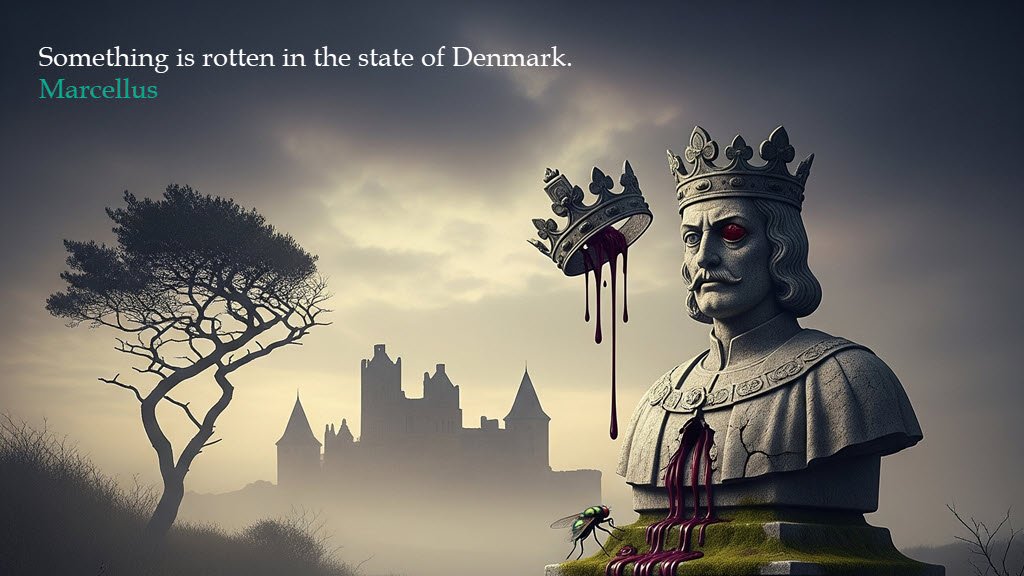
| MARCELLUS: Something is rotten in the state of Denmark. | Something is wrong in Denmark. |
| HORATIO: Heaven will direct it. | Heaven will make it right. |
| MARCELLUS: Nay, let’s follow him. | No, let’s follow him. |
| Exeunt. | [They exit.] |
Introductory Notes
Act 1, Scene 4 of Hamlet is a masterclass in dramatic tension and thematic complexity. This scene marks the long-anticipated encounter between the Prince and the ghost of his father and serves as a crucial moment in the development of the play’s central ideas.
The “Vicious Mole of Nature” Speech: A Philosophical and Political Reflection
The scene begins not with the Ghost but with the sound of Claudius’s drunken festivities. Hamlet is appalled by the blare of trumpets and cannon fire. He explains to Horatio that the King’s custom of excessive drinking tarnishes Denmark’s reputation, making it appear a nation of “drunkards” and “swinish” people. This prompts Hamlet to launch into a philosophical reflection on human frailty. He proposes that a single, inherent flaw—a “vicious mole of nature”—can overshadow a person’s or a nation’s otherwise noble qualities.
This speech is pivotal for two reasons. First, it reveals Hamlet’s tendency to intellectualize and generalize from specific instances. He takes his uncle’s moral failing and extrapolates it into a broader theory of corruption. This inclination toward abstraction and reflection, often at the expense of action, defines his character throughout the play. Second, the speech serves as a metaphorical diagnosis of Denmark itself. Hamlet connects Claudius’s private vice (his drunkenness) to a national disgrace, suggesting that individual moral failure can have political consequences. The “dram of evil,” capable of corrupting “noble substance,” aptly describes Claudius’s usurpation of the throne—an act that has sullied the entire kingdom.
The Ghost’s “Questionable Shape”: Supernatural Ambiguity and Moral Uncertainty
The dramatic peak of the scene occurs with the Ghost’s appearance. Its ambiguous nature becomes a driving force in the narrative and a central theme of the play. Hamlet’s first words to the apparition—”Angels and ministers of grace defend us!”—followed by his question of whether it is a “spirit of health or goblin damn’d,” immediately place the moment within the religious anxieties of the Elizabethan era. The Protestant Reformation had rejected the Catholic notion of spirits returning from Purgatory, rendering the Ghost’s nature deeply uncertain for both characters and audience.
This uncertainty is more than a theatrical device; it underpins Hamlet’s central moral dilemma. His intellectual disposition compels him to question the Ghost’s intentions. Is it a just spirit urging him to seek vengeance, or a malevolent force aiming to damn his soul by inciting murder? The Ghost’s “questionable shape” symbolizes Hamlet’s internal conflict—the tension between his desire for justice and his fear of being misled by an evil power.
Character Dynamics: Impulse, Reason, and Foreshadowed Madness
The scene draws a sharp contrast between Hamlet’s impulsive defiance and Horatio’s cautious rationality. Both Horatio and Marcellus are alarmed by the Ghost and try to stop Hamlet from following it, warning that it could “deprive [his] sovereignty of reason and draw [him] into madness.” This moment foreshadows the psychological unrest that will later overwhelm Hamlet.
Hamlet’s response is striking. He asserts, “I do not set my life at a pin’s fee,” revealing how little he now values his life following his father’s death. His decision to follow the Ghost is not simply bravado; it reflects his grief and deep need for truth. His belief that his “immortal” soul cannot be harmed by the apparition reflects both courage and fatalism. The conflict between Hamlet’s drive to uncover the truth and his friends’ protective restraint anticipates the broader internal struggle that defines the play.
A Diseased Body: From Private Vice to National Corruption
The scene concludes with Marcellus’s now-famous line: “Something is rotten in the state of Denmark.” This declaration encapsulates the scene’s central themes of corruption and unease. The metaphorical “rot” stems from Claudius’s personal depravity, which has infected the realm as a whole.
This line carries dramatic irony. While Marcellus speaks from suspicion, the audience already knows the cause: Claudius’s regicide and incestuous marriage. This moment shifts the narrative from a story of personal loss and revenge to a broader national crisis. Denmark is presented as a diseased body, corrupted by one man’s crime. As the scene ends, Hamlet, driven by a brilliant yet troubled mind, follows a spirit of uncertain origin, prepared to confront a world that has become “out of joint.”
How well do you know the scene?
The following quiz is designed to ensure a total understanding of every plot element and significant detail within the scene. Each question has been carefully constructed to assess knowledge of character, plot, setting, and thematic foreshadowing, with a limit of three choices. Use blank piece of paper and write down your answers. Then, click on the next toggle down to see the answers.
1. Which of the following characters is NOT present on the platform at the beginning of the scene?
A. Hamlet
B. Marcellus
C. Barnardo
2. What time is it when the scene begins?
A. It is just past midnight.
B. It is just before midnight.
C. It is just before sunrise.
3. According to Hamlet, what is the meaning of the flourish of trumpets and ordnance?
A. It signals a new moon, which is a time for ceremony.
B. It is a custom celebrating Claudius’s drunken revelry.
C. It is a military salute to a visiting foreign dignitary.
4. How does Hamlet describe the Danish custom of drunken celebration?
A. A tradition that is a bit strange but ultimately harmless.
B. A custom that is more honored in the breach than the observance.
C. An ancient custom of which he is deeply proud.
5. In Hamlet’s view, how does the Danish drinking custom affect the nation’s reputation?
A. It earns them a reputation as a festive and welcoming people.
B. It does not affect their reputation, as it is a private affair.
C. It makes them “traduced and tax’d of other nations” as drunkards.
6. Hamlet’s speech about the “vicious mole of nature” serves to:
A. Condemn all human beings as inherently evil.
B. Explain how a single, inborn flaw can corrupt an otherwise virtuous person or nation.
C. Argue that one’s personal reputation is never affected by their vices.
7. When the Ghost appears, what does Hamlet’s first line, “Angels and ministers of grace defend us!” suggest about his reaction?
A. He is immediately convinced that it is his father’s spirit.
B. He is certain that the Ghost is a demonic entity.
C. He is unsure of the Ghost’s nature and fears it might be evil.
8. Hamlet describes the Ghost as coming in a “questionable shape.” What does this phrase mean?
A. The Ghost’s physical appearance is disfigured.
B. The Ghost’s origin and purpose are open to question.
C. The Ghost is beckoning him to follow it.
9. Why does the Ghost beckon Hamlet to a more “removed ground”?
A. To reveal the location of a hidden treasure.
B. To speak with Hamlet alone.
C. To lead Hamlet to the edge of the cliff.
10. What do Horatio and Marcellus initially advise Hamlet to do?
A. To follow the Ghost immediately.
B. To ignore the Ghost, as it is a figment of his imagination.
C. To not follow the Ghost and to be cautious.
11. Hamlet famously states, “I do not set my life at a pin’s fee.” What does this line reveal about his state of mind?
A. He is so distraught by grief that he does not value his own life.
B. He is a coward and believes his life is worth very little.
C. He is so happy that he feels his life is priceless.
12. What specific fear does Horatio express about Hamlet following the Ghost?
A. That it will tell him a false story about his father’s death.
B. That it will lead him to a cliff and cause him to go mad or kill himself.
C. That it will reveal a hidden weakness to the Danish court.
13. What literary device is used when Hamlet compares his body’s arteries to the “Nemean lion’s nerve”?
A. Simile
B. Allusion
C. Metaphor
14. How do Horatio and Marcellus react when Hamlet resolves to follow the Ghost?
A. They try to physically restrain him.
B. They agree to follow him from a distance.
C. They decide to return to the castle and wait.
15. What does Hamlet threaten to do if Horatio and Marcellus “let” (hinder) him?
A. He will fight them and make a ghost of one of them.
B. He will renounce his claim to the throne.
C. He will never speak to them again.
16. What is the symbolic significance of the Ghost’s appearance and beckoning in this scene?
A. It symbolizes a call for Hamlet to return to his studies.
B. It serves as a catalyst for the play’s action and Hamlet’s quest for vengeance.
C. It represents Hamlet’s unresolved grief and nothing more.
17. What does Horatio mean when he says Hamlet “waxes desperate with imagination”?
A. Hamlet’s mind is growing increasingly reckless and unhinged by the situation.
B. Hamlet is being cowardly and overly cautious.
C. Hamlet’s physical strength is increasing.
18. Marcellus’s famous final line, “Something is rotten in the state of Denmark,” is an example of what literary device?
A. Personification
B. Dramatic irony
C. Hyperbole
19. In the context of the play’s larger themes, what does Marcellus’s line primarily indicate?
A. That the Danish weather is unusually bad.
B. That a moral and political corruption has infected the kingdom.
C. That Denmark’s military defenses are weak.
20. What do Horatio and Marcellus decide to do at the very end of the scene?
A. They decide to run after Hamlet and the Ghost.
B. They go to inform the new King of the strange events.
C. They agree to let Hamlet go alone and wait for his return.
Answers
| Question Number | Correct Answer | Concept Tested | Rationale |
|---|---|---|---|
| 1 | C | Plot/Character | The scene begins with the watch on the platform, consisting of Hamlet, Horatio, and Marcellus. Barnardo, a guard from the first scene, is not present here. |
| 2 | B | Plot/Setting | The dialogue between Horatio and Marcellus establishes that it is “near the season” when the spirit walks, with Marcellus correcting Horatio that it is “struck” twelve, meaning it has just turned midnight or is very close to it. The ominous mood is set by the cold, biting air and the late hour. |
| 3 | B | Plot/Theme: Corruption | The flourish of trumpets and ordnance announces that the King is “wak[ing] tonight and tak[ing] his rouse”. Hamlet explains this is a custom to celebrate Claudius’s drunken merrymaking, which he finds distasteful and corrupt. |
| 4 | B | Character/Theme: Appearance vs. Reality | Hamlet’s line, “more honour’d in the breach than the observance,” is a direct criticism of the custom. He believes it would be better for Denmark’s reputation to break this tradition than to follow it, linking the public display of indulgence to internal corruption. |
| 5 | C | Character/Theme: Corruption | Hamlet states that the “heavy-headed revel” makes the Danes “traduced and tax’d of other nations”. The revelry makes Denmark look “swinish” and its people like “drunkards,” which detracts from the nation’s achievements. |
| 6 | B | Theme/Literary Criticism | Hamlet’s speech is a universal philosophical statement on the nature of flaws. He argues that a single, minor defect (“a vicious mole of nature”) can corrupt a person’s entire reputation, overpowering their otherwise noble qualities. This functions as a metaphorical diagnosis of the entire Danish state. |
| 7 | C | Character/Theme: Supernatural | Hamlet’s immediate call for heavenly protection, “Angels and ministers of grace defend us!” indicates his uncertainty about the Ghost’s true nature. His subsequent lines, “Be thou a spirit of health or goblin damn’d,” solidify this ambiguity. |
| 8 | B | Theme/Supernatural | The Ghost appears in a “questionable shape,” a phrase that means its identity is open to question or debate. This reflects the play’s central ambiguity regarding the supernatural, which was a subject of religious debate in the Elizabethan era. |
| 9 | B | Plot | The Ghost “beckons” Hamlet with a “courteous action”. Horatio correctly interprets this as the Ghost desiring to impart something to Hamlet “alone”. |
| 10 | C | Plot/Character | Horatio and Marcellus are “freaked out” and tell Hamlet not to follow the Ghost. They represent caution and reason, fearing the Ghost is an evil spirit with wicked intentions. |
| 11 | A | Character/Theme: Grief | The phrase “I do not set my life at a pin’s fee” reveals Hamlet’s profound grief and recklessness. He has lost all value for his life due to his father’s death and mother’s betrayal, making him fearless about following the Ghost. |
| 12 | B | Theme: Madness/Foreshadowing | Horatio explicitly warns Hamlet that the Ghost might lead him to the “dreadful summit of the cliff” and then “deprive your sovereignty of reason / And draw you into madness”. This serves as crucial foreshadowing for Hamlet’s later behavior and his feigned madness. |
| 13 | B | Literary Device | The “Nemean lion” is a reference to a mythological beast from Greek legend that was famously strong. The comparison is therefore an allusion, a reference to an outside work or body of knowledge. |
| 14 | A | Plot | When Hamlet resolves to follow, his friends try to physically restrain him, telling him, “You shall not go, my lord”. This demonstrates their genuine fear and concern for his safety. |
| 15 | A | Character/Foreshadowing | Hamlet’s threat, “By heaven, I’ll make a ghost of him that lets me,” is a moment of impulsive violence that foreshadows his later rash actions, such as his killing of Polonius. |
| 16 | B | Symbolism | The Ghost’s appearance is a “pivotal moment” that sets the plot in motion. It catalyzes Hamlet’s quest for vengeance and is a “constant reminder of death’s omnipotence”. |
| 17 | A | Character | Horatio concludes that Hamlet is “desperate with imagination”. This refers to Hamlet’s increasingly reckless and unhinged state of mind as he grapples with the supernatural event. |
| 18 | B | Literary Device | Marcellus’s line is a powerful example of dramatic irony. The audience knows that the “rot” is caused by Claudius, the regicide, while the characters themselves have no idea. |
| 19 | B | Theme: Corruption/State of Denmark | The “rotten” line is the culmination of a motif of moral and political corruption that runs through the play. It suggests that the king’s private moral decay (Claudius’s actions and revelry) has infected the entire “body politic” of the nation. |
| 20 | A | Plot | Despite their initial hesitation, Horatio and Marcellus decide to follow Hamlet and the Ghost. They realize they cannot simply leave Hamlet to face the unknown alone. |
Contents
- Audio Version of the Scene
- Modern Text Version
- Introductory Notes
- The “Vicious Mole of Nature” Speech: A Philosophical and Political Reflection
- The Ghost’s “Questionable Shape”: Supernatural Ambiguity and Moral Uncertainty
- Character Dynamics: Impulse, Reason, and Foreshadowed Madness
- A Diseased Body: From Private Vice to National Corruption
- How well do you know the scene?
- Answers