
A Crown Corrupted, a Soul Unbound
Audio Version of the Scene
Modern Text Version
Hamlet – Act 1, Scene 5 – A Crown Corrupted, a Soul Unbound
The platform before the castle.
| Original Text | Modern English |
|---|---|
| Enter GHOST and HAMLET. | [The Ghost and Hamlet enter.] |
| HAMLET: Whither wilt thou lead me? Speak; I’ll go no further. | Where are you leading me? Speak; I won’t go any further. |
| GHOST: Mark me. | Pay attention to me. |
| HAMLET: I will. | I will. |
| GHOST: My hour is almost come, When I to sulphurous and tormenting flames Must render up myself. | My time is almost up, when I must return to the fiery and tormenting flames of Purgatory. |
| HAMLET: Alas, poor ghost! | Oh, poor ghost! |
| GHOST: Pity me not, but lend thy serious hearing To what I shall unfold. | Don’t pity me, but listen carefully to what I will reveal. |
| HAMLET: Speak; I am bound to hear. | Speak; I am ready and eager to listen. |
| GHOST: So art thou to revenge, when thou shalt hear. | You’ll be just as eager to get revenge once you hear. |
| HAMLET: What? | What? |
| GHOST: I am thy father’s spirit, Doom’d for a certain term to walk the night, And for the day confined to fast in fires, Till the foul crimes done in my days of nature Are burnt and purged away. But that I am forbid To tell the secrets of my prison-house, I could a tale unfold whose lightest word Would harrow up thy soul, freeze thy young blood, Make thy two eyes, like stars, start from their spheres, Thy knotted and combined locks to part, And each particular hair to stand on end, Like quills upon the fretful porpentine. | I am the spirit of your father, condemned for a certain time to walk the night and, during the day, to suffer in fire, until the terrible sins I committed in life are burned away and purified. But I am forbidden from telling the secrets of my prison, or I could tell a story whose slightest word would torture your soul, freeze your young blood, make your eyes pop out of your head like stars, separate the hair on your head, and make each individual hair stand on end like quills on a scared porcupine. |
| But this eternal blazon must not be To ears of flesh and blood. List, list, O, list! If thou didst ever thy dear father love— | But I am not allowed to describe this eternal suffering to mortal ears. Listen, listen, oh, listen! If you ever loved your dear father… |
| HAMLET: O God! | Oh, God! |
| GHOST: Revenge his foul and most unnatural murder. | Avenge his horrible and most unnatural murder. |
| HAMLET: Murder! | Murder! |
| GHOST: Murder most foul, as in the best it is; But this most foul, strange, and unnatural. | Murder most foul, as all murders are, but this one was especially foul, strange, and unnatural. |
| HAMLET: Haste me to know’t, that I, with wings as swift As meditation or the thoughts of love, May sweep to my revenge. | Tell me quickly, so that I, with a mind as swift as a thought, can fly to my revenge. |
| GHOST: I find thee apt; And duller shouldst thou be than the fat weed That rots itself in ease on Lethe wharf, Wouldst thou not stir in this. Now, Hamlet, hear: ’Tis given out that, sleeping in my orchard, A serpent stung me; so the whole ear of Denmark Is by a forged process of my death Rankly abus’d: but know, thou noble youth, The serpent that did sting thy father’s life Now wears his crown. | I see you are ready. And you would have to be more sluggish than the weeds that rot on the banks of the river of forgetfulness if you didn’t act on this. Now, Hamlet, listen: it’s been said that a serpent stung me while I was sleeping in my orchard. So all of Denmark has been wickedly deceived by a false story of my death. But know this, noble young man: the serpent that took your father’s life now wears his crown. |
| HAMLET: O my prophetic soul! My uncle! | Oh, my soul already knew it! My uncle! |
| GHOST: Ay, that incestuous, that adulterate beast, With witchcraft of his wit, with traitorous gifts, O wicked wit and gifts, that have the power So to seduce!—won to his shameful lust The will of my most seeming-virtuous queen: O Hamlet, what a falling-off was there! | Yes, that incestuous, adulterous animal, with his clever words and treacherous gifts—oh, what wicked words and gifts that have such power to seduce!—won over my seemingly virtuous queen to his shameful lust. Oh Hamlet, what a terrible downfall that was! |
| From me, whose love was of that dignity That it went hand in hand even with the vow I made to her in marriage, and to decline Upon a wretch whose natural gifts were poor To those of mine! | She fell from me, whose love was as noble and pure as the vows I made to her in our marriage, to stoop to a wretch whose natural qualities were nothing compared to mine! |
| But soft! methinks I scent the morning air; Brief let me be. Sleeping within my orchard, My custom always of the afternoon, Upon my secure hour thy uncle stole, With juice of cursed hebenon in a vial, And in the porches of my ears did pour The leperous distillment; whose effect Holds such an enmity with blood of man That swift as quicksilver it courses through The natural gates and alleys of the body, And with a sudden vigour it doth posset And curd, like eager droppings into milk, The thin and wholesome blood: so did it mine; And a most instant tetter bark’d about, Most lazar-like, with vile and loathsome crust All my smooth body. | But be quiet! I think I smell the morning air. I must be brief. While I was sleeping in my orchard, as I always did in the afternoon, your uncle crept up on me. He carried a vial of a cursed poison called hebenon and poured the vile liquid into my ears. The poison is so hateful to human blood that it races through the body as quickly as mercury, and it suddenly curdles the blood, just like a sour drop of milk curdles fresh milk. It did the same to my blood. A hideous rash immediately broke out all over my smooth skin, covering it with a vile, disgusting crust, just like a leper. |
| Thus was I, sleeping, by a brother’s hand Of life, of crown, of queen, at once dispatch’d: Cut off even in the blossoms of my sin, Unhousel’d, disappointed, unaneled, No reckoning made, but sent to my account With all my imperfections on my head: O, horrible! O, horrible! most horrible! | So, while I was sleeping, I was instantly robbed of my life, my crown, and my queen by my brother’s hand. I was cut off in the full bloom of my sins, without receiving the Last Rites, unprepared, and with all my sins still clinging to me. Oh, how horrible! Oh, how horrible! Most horrible! |
| If thou hast nature in thee, bear it not; Let not the royal bed of Denmark be A couch for luxury and damn’d incest. But, howsoever thou pursuest this act, Taint not thy mind, nor let thy soul contrive Against thy mother aught: leave her to heaven, And to those thorns that in her bosom lodge, To prick and sting her. | If you are a true son, do not tolerate this. Don’t let the royal bed of Denmark be a place for immoral lust and damned incest. But, no matter how you carry out this revenge, do not corrupt your own mind, and do not plot anything against your mother. Leave her to the judgment of Heaven, and to the guilt in her heart that will torment her. |
| Farewell, adieu! thy cousin with the morning’s breath; brief, adieu! The glow-worm shows the matin to be near, And ‘gins to pale his uneffectual fire: Adieu, adieu! Hamlet, remember me. | Farewell, goodbye! The morning breeze is approaching; quickly, goodbye! The glow-worm’s light is fading, showing that dawn is near. Goodbye, goodbye! Hamlet, remember me. |
| Exit. | [The Ghost exits.] |
| HAMLET: O all you host of heaven! O earth! what else? And shall I couple hell? O, fie! Hold, hold, my heart; And you, my sinews, grow not instant old, But bear me stiffly up. Remember thee! Ay, thou poor ghost, while memory holds a seat In this distracted globe. Remember thee! Yea, from the table of my memory I’ll wipe away all trivial fond records, All saws of books, all forms, all pressures past, That youth and observation copied there; And thy commandment all alone shall live Within the book and volume of my brain, Unmix’d with baser matter: yes, by heaven! | Oh, all you angels in heaven! Oh, earth! What else? Should I include hell? Oh, shame! Hold firm, my heart. And my muscles, don’t grow old right now, but support me. Remember you! Yes, you poor ghost, as long as my mind has any memory. Remember you! Yes, I will erase from the tablet of my memory all insignificant past lessons, all sayings from books, all past images, everything that youth and experience have taught me. Your command alone will live in the book of my mind, unmixed with any other, lower thoughts. Yes, I swear it! |
| O most pernicious woman! O villain, villain, smiling, damned villain! My tables,—meet it is I set it down, That one may smile, and smile, and be a villain; At least I’m sure it may be so in Denmark: [Writes.] So, uncle, there you are. Now to my word; It is ‘Adieu, adieu! remember me.’ I have sworn ’t. | Oh, you most evil woman! Oh, you villain, villain, you smiling, damned villain! My notebook—it is necessary for me to write this down: that one can smile and smile and still be a villain. At least I know that is true in Denmark. [He writes.] So, uncle, that’s what you are. Now to my promise: “Goodbye, goodbye! Remember me.” I have sworn it. |
| HORATIO: [Within.] My lord, my lord,— | [From offstage] My lord, my lord— |
| MARCELLUS: [Within.] Lord Hamlet,— | [From offstage] Lord Hamlet— |
| HORATIO: [Within.] Heaven secure him! | [From offstage] May Heaven protect him! |
| HAMLET: So be it! | So be it! |
| MARCELLUS: [Within.] Hillo, ho, ho, my lord! | [From offstage] Halloo, my lord! |
| HAMLET: Hillo, ho, ho, boy! Come, and come. | Hello! Come here. |
| Enter HORATIO and MARCELLUS. | [Horatio and Marcellus enter.] |
| MARCELLUS: How is’t, my noble lord? | How are you, my noble lord? |
| HORATIO: What news, my lord? | What’s the news, my lord? |
| HAMLET: O, wonderful! | Oh, it’s wonderful! |
| HORATIO: Good my lord, tell us. | My good lord, tell us. |
| HAMLET: No; you’ll reveal it. | No; you’ll tell people. |
| HORATIO: Not I, my lord, by heaven. | Not me, my lord, I swear. |
| MARCELLUS: Nor I, my lord. | Nor me, my lord. |
| HAMLET: How say you, then; would heart of man once think it? But you’ll be secret? | What do you say, then? Would a person ever believe it? You’ll keep it secret? |
| HORATIO: Ay, by heaven, my lord. | Yes, I swear, my lord. |
| HAMLET: There’s ne’er a villain dwelling in all Denmark But he’s an arrant knave. | There’s not a single villain in all of Denmark that isn’t a total scoundrel. |
| HORATIO: There needs no ghost, my lord, come from the grave To tell us this. | We don’t need a ghost to come from the grave to tell us that, my lord. |
| HAMLET: Why, right; you are i’ the right; And so, without more circumstance at all, I hold it fit that we shake hands and part: You, as your business and desire shall point you— For every man has business and desire, Such as it is—and for my own poor part, Look you, I’ll go pray. | Why, you’re right; you’re absolutely right. So, without further explanation, I think it’s best we shake hands and go our separate ways. You’ll go about your business as you wish—since every person has business and desires—and as for me, well, I’m going to go pray. |
| HORATIO: These are but wild and whirling words, my lord. | These are just wild and crazy words, my lord. |
| HAMLET: I am sorry they offend you, heartily; Yes, faith, heartily. There’s a villain, Laertes, in this bag. | I am truly sorry they offend you. Truly. There’s a villain, Laertes, in this sack. |
| HORATIO: There’s no offence, my lord. | There’s no offense taken, my lord. |
| HAMLET: Yes, by Saint Patrick, but there is, Horatio, And much offence, too. Touching this vision here, It is an honest ghost, that let me tell you. For your desire to know what is between us, O’ermaster it as you may. And now, good friends, As you are friends, scholars and soldiers, Give me one poor request. | Yes, I swear on Saint Patrick, there is, Horatio, and a great offense too. About this ghost—it’s a real ghost, I can tell you that. As for your desire to know what we talked about, control your curiosity as best you can. And now, my good friends, as you are my friends, scholars, and soldiers, grant me one small request. |
| HORATIO: What is’t, my lord? We will. | What is it, my lord? We will do it. |
| HAMLET: Never make known what you have seen to-night. | Never reveal what you have seen tonight. |
| HORATIO & MARCELLUS: My lord, we will not. | My lord, we will not. |
| HAMLET: Nay, but swear’t. | No, but swear to it. |
| HORATIO: In faith, My lord, not I. | Honestly, my lord, I won’t. |
| MARCELLUS: Nor I, my lord, in faith. | Nor I, my lord, honestly. |
| HAMLET: Upon my sword. | Swear upon my sword. |
| MARCELLUS: We have sworn, my lord, already. | We’ve already sworn, my lord. |
| HAMLET: Indeed, upon my sword, indeed. | No, truly, upon my sword, I insist. |
| GHOST: [Cries from beneath the stage.] Swear. | [From beneath the stage] Swear. |
| HAMLET: Ah, ha, boy! say’st thou so? Art thou there, truepenny? Come on—you hear this fellow in the cellarage: Consent to swear. | Ah, ha, my friend! You say that? Are you there, old friend? Come on, you hear the ghost in the cellar. Agree to swear. |
| HORATIO: Propose the oath, my lord. | Tell us the oath, my lord. |
| HAMLET: Never to speak of this that you have seen, Swear by my sword. | Never to speak of what you have seen. Swear by my sword. |
| GHOST: [Beneath.] Swear. | [Beneath] Swear. |
| HAMLET: Hic et ubique? then we’ll shift our ground. Come hither, gentlemen, And lay your hands again upon my sword: Never to speak of this that you have heard, Swear by my sword. | Here and everywhere? Then we will move. Come here, gentlemen, and put your hands on my sword again. Never to speak of what you have heard, swear by my sword. |
| GHOST: [Beneath.] Swear. | [Beneath] Swear. |
| HAMLET: Well said, old mole! canst work i’ the earth so fast? A worthy pioner! Once more remove, good friends. | Well said, old mole! Can you dig through the earth so fast? What a good digger! Let’s move once more, my friends. |
| HORATIO: O day and night, but this is wondrous strange! | Oh, day and night, this is unbelievably strange! |
| HAMLET: And therefore as a stranger give it welcome. There are more things in heaven and earth, Horatio, Than are dreamt of in your philosophy. But come; Here, as before, never, so help you mercy, How strange or odd soe’er I bear myself, As I perchance hereafter shall think meet To put an antic disposition on, That you, at such times seeing me, never shall, With arms encumber’d thus, or this headshake, Or by pronouncing of some doubtful phrase, As ‘Well, well, we know,’ or ‘We could, an if we would,’ Or ‘If we list to speak,’ or ‘There be, an if they might,’ Or such ambiguous giving out, to note That you know aught of me: this do you swear, So grace and mercy at your most need help you. | And for that reason, you should welcome it like a stranger. There are more things in heaven and on earth, Horatio, than your philosophy can even imagine. But come. Here, as before, swear—so may God have mercy on you—that no matter how strangely or bizarrely I act from now on—as I might think it necessary to pretend to be mad—you will never, when you see me, cross your arms or shake your head, or say something vague like, “Well, well, we know,” or “We could, if we wanted to,” or “If we chose to speak,” or “There are people who know, if they could,” or any other hints that you know anything about me. Swear this, so that God’s grace and mercy will help you when you most need it. |
| GHOST: [Beneath.] Swear. | [Beneath] Swear. |
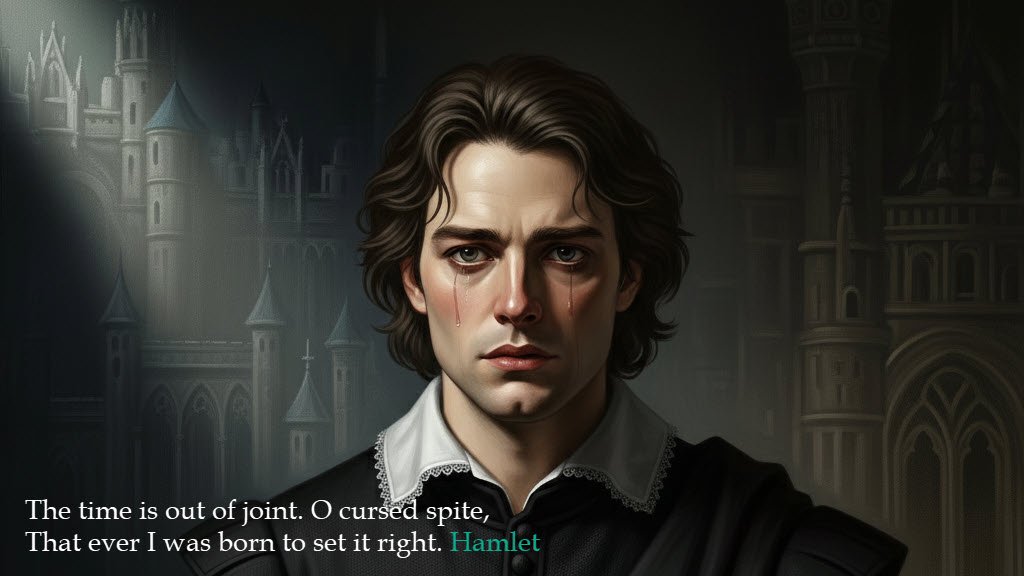
| HAMLET: Rest, rest, perturbed spirit! [They swear.] So, gentlemen, With all my love I do commend me to you; And what so poor a man as Hamlet is May do, to express his love and friendship to you, God willing, shall not lack. Let us go in together; And still your fingers on your lips, I pray. The time is out of joint: O cursed spite, That ever I was born to set it right! Nay, come, let’s go together. | Rest, rest, troubled spirit! [They swear.] So, gentlemen, I give you all my love and trust myself to you. And whatever a poor man like Hamlet can do to show his love and friendship, God willing, will not be forgotten. Let’s go in together. And keep your fingers on your lips. I beg you. The world is out of order. Oh, what a terrible burden, that I was born to fix it! No, come, let’s go together. |
| Exeunt. | [They exit.] |
Introductory Notes
Act 1, Scene 5 is a pivotal turning point in Hamlet, serving as the catalyst that transforms the protagonist’s private grief and suspicion into a public mission. It moves beyond summary into a critical analysis of the scene’s narrative, psychological, and thematic functions, setting the foundation for the tragedy that follows.
The Narrative Turning Point: Plot and Structure
The primary function of this scene is to provide Hamlet with concrete evidence of his uncle’s guilt and to assign him a morally complex directive. It begins with the Ghost of King Hamlet leading the Prince away from Horatio and Marcellus to a secluded part of the battlements. Identifying itself as Hamlet’s father, the Ghost reveals that its suffering in the afterlife is a result of “foul crimes done in my days of nature.” This admission, delivered as the Ghost prepares to return to “sulphurous and tormenting flames,” imposes a pressing timeline for revenge.
The Ghost’s command for vengeance forms the core of the scene. It urges Hamlet to “Revenge his foul and most unnatural murder.” The official story—that the King died from a serpent bite while sleeping in his orchard—is exposed as a “forged process.” The Ghost reveals the truth: “The serpent that did sting thy father’s life now wears his crown,” confirming Hamlet’s worst suspicions about Claudius. The Ghost describes in detail how Claudius murdered the King, sneaking up on him while he slept and pouring henbane poison into his ear, which caused his blood to curdle and his skin to erupt in a “vile and loathsome crust.”
The Ghost issues a twofold command, introducing a central moral dilemma for Hamlet. While demanding Claudius’s death, it instructs him to spare Queen Gertrude: “Taint not thy mind, nor let thy soul contrive against thy mother aught. Leave her to heaven, and to those thorns that in her bosom lodge to prick and sting her.” This contradictory instruction leaves Hamlet in a paralyzing bind regarding his mother, an inner conflict that will trouble him throughout the play. As dawn approaches, marked by the fading light of the glow-worm, the Ghost departs, leaving Hamlet alone with his oath and the weight of the command.
After the Ghost vanishes, Horatio and Marcellus return. Alarmed by Hamlet’s “wild and whirling words” and apparent distress, they press him for answers. Hamlet refuses and insists they swear upon his sword to secrecy. A striking theatrical moment follows: the Ghost’s voice echoes from beneath the stage, repeating “Swear!” to underscore the seriousness of the vow.
Character in Crisis: The Psychological Landscape
This scene offers a close study of Hamlet’s psychological transformation. He shifts from a grieving scholar to a man driven by purpose, though his resolve is instantly complicated. He promises to act with “wings as swift as meditation or the thoughts of love.” This simile reveals his divided nature: his determination is tied to the same introspective tendencies that will later hinder him. He vows to “wipe away all trivial fond records” from the “table of [his] memory,” preserving only the Ghost’s directive.
The Ghost’s identity remains an interpretive challenge. Its suffering in “sulphurous and tormenting flames” aligns with the Catholic notion of purgatory, a contentious concept in Protestant England. However, its call for revenge contradicts Christian doctrine, which discourages retributive violence. This paradox complicates the Ghost’s credibility. Is its motive justice, or merely an attempt to end its torment? The Ghost later returns to “whet [Hamlet’s] almost blunted purpose,” suggesting an ongoing desperation that casts doubt on its purity of intent. These contradictions elevate the play beyond a typical revenge tragedy, inviting philosophical inquiry into morality and the afterlife.
Hamlet’s emotional state after the encounter is highly unstable. His language becomes fragmented and erratic; he even refers to the Ghost as “truepenny” and “old mole,” terms that oscillate between humor and madness. His declaration that he will “put an antic disposition on” is not a strategic plan but a disoriented response to psychological trauma. Hamlet’s reality has been irrevocably altered: his uncle is a murderer, his mother complicit in “damned incest,” and the moral order is “out of joint.” His decision to feign madness is both a defense mechanism and an expression of his inner collapse. The boundary between pretense and reality blurs, suggesting that his madness is not entirely artificial but reflective of a fractured self in a corrupted world.
The Scene’s Enduring Themes
Act 1, Scene 5 establishes several of the play’s enduring themes. The Ghost’s demand for vengeance introduces the central conflict and examines the cost of fulfilling a duty to the dead. The theme of appearance versus reality is also foregrounded. Claudius, a “smiling, damnèd villain,” is revealed to be a fraud. In response, Hamlet chooses to adopt his own disguise, intending to act mad while he investigates further.
Imagery of poison and disease pervades the scene. The ear poisoning is both a literal murder and a symbol of corruption infecting the Danish court. The Ghost’s remark that the kingdom has been “rankly abused” and Hamlet’s observation that “The time is out of joint” reinforce the sense of Denmark as a diseased body politic. Hamlet sees himself as the one “born to set it right,” assuming the role of moral and political avenger.
How well do you know the scene?
The following quiz is designed to ensure a total understanding of every plot element and significant detail within the scene. Each question has been carefully constructed to assess knowledge of character, plot, setting, and thematic foreshadowing, with a limit of three choices. Use blank piece of paper and write down your answers. Then, click on the next toggle down to see the answers.
1. At the beginning of the scene, what is Hamlet’s initial reaction to the Ghost’s command?
A. He refuses to go further until the Ghost explains its purpose.
B. He immediately agrees to follow the Ghost wherever it leads.
C. He is so terrified he is unable to move.
2. The Ghost states that it is condemned to a certain term of suffering. Where is it confined during the day?
A. To the dungeons of the castle.
B. To fast in fires.
C. To wander the earth as a spirit.
3. The Ghost describes its afterlife torment using what kind of imagery?
A. Fire and brimstone.
B. Knotted locks and a fretful porcupine.
C. Stars falling from their spheres.
4. What is the official story of King Hamlet’s death, as told to the people of Denmark?
A. He was killed in a fencing match.
B. He was stung by a serpent while sleeping in his orchard.
C. He died from a sudden illness.
5. What does the Ghost reveal to Hamlet about the true cause of his death?
A. He was poisoned by Claudius.
B. He was killed by a vengeful spirit.
C. He committed suicide.
6. How did the poison that Claudius used affect King Hamlet’s body?
A. It caused his heart to stop instantly.
B. It curdled his blood and covered his body in a leper-like crust.
C. It made him deaf and mute.
7. According to the Ghost, what did Claudius steal from him?
A. His life, his crown, and his queen.
B. His honor, his power, and his riches.
C. His kingdom, his army, and his son’s love.
8. The Ghost describes Claudius as an “incestuous” and “adulterate beast.” How did Claudius win over Gertrude?
A. With physical strength and dominance.
B. With witchcraft of his wit and traitorous gifts.
C. By threatening her and her son.
9. What specific instruction does the Ghost give Hamlet regarding Queen Gertrude?
A. That he should kill her as a traitor.
B. That he should leave her to heaven and her own conscience.
C. That he should force her to confess her sins publicly.
10. What literary device is at play when the Ghost says, “The serpent that did sting thy father’s life now wears his crown”?
A. Personification.
B. Allusion.
C. Metaphor.
11. What is Hamlet’s immediate reaction upon hearing that his uncle is the murderer?
A. He says, “O my prophetic soul! My uncle!”
B. He cries out in disbelief and anger.
C. He immediately plots a specific revenge plan.
12. After the Ghost leaves, Hamlet says he will wipe away all trivial records from his memory except for what?
A. The face of his father’s murderer.
B. His love for Ophelia.
C. The Ghost’s commandment.
13. What is the symbolic meaning of Claudius pouring poison into King Hamlet’s ear?
A. It represents the physical weakness of the old King.
B. It symbolizes the way Claudius has corrupted the entire kingdom with lies.
C. It shows Claudius’s skill as an alchemist.
14. When Horatio and Marcellus return, they find Hamlet in what kind of emotional state?
A. Calm and resolute.
B. Wild and agitated.
C. Filled with sorrow and grief.
15. What does Hamlet initially refuse to tell his friends, Horatio and Marcellus?
A. The cause of his grief.
B. The nature of his encounter with the Ghost.
C. His intentions to leave Denmark.
16. How does Hamlet force Horatio and Marcellus to swear their oath of secrecy?
A. He holds them at knifepoint.
B. He makes them swear on his sword.
C. He threatens to kill himself if they do not swear.
17. What phrase does the Ghost use from beneath the stage to confirm the oath?
A. “Remember me.”
B. “Swear.”
C. “Fare thee well.”
18. What plan does Hamlet reveal to his friends to explain his future behavior?
A. He will leave Denmark and join the army.
B. He will go to the church to pray and seek divine guidance.
C. He may “put an antic disposition on,” or pretend to be mad.
19. What does Hamlet say at the end of the scene about the state of Denmark?
A. “Something is rotten in the state of Denmark.”
B. “The time is out of joint.”
C. “I must be cruel only to be kind.”
20. What is the central moral dilemma introduced by the Ghost’s dual command?
A. Hamlet must choose between avenging his father and saving his kingdom.
B. Hamlet must punish Claudius but spare his mother.
C. Hamlet must expose Claudius’s crime without revealing the Ghost’s existence.
Answers
| Question Number | Correct Answer | Question Type and Key Concept Assessed | Justification and Reference |
|---|---|---|---|
| 1 | A | Plot, Character: Hamlet’s initial caution and obedience. | This question tests a student’s attention to the opening dialogue. Hamlet’s initial hesitation (“I’ll go no further”) quickly gives way to obedience (“Speak; I am bound to hear”), establishing his dual nature of intellect and filial duty. |
| 2 | B | Plot, Theme: The Ghost’s state in the afterlife. | This probes the supernatural and religious aspects of the scene. The Ghost’s mention of being “confined to fast in fires” links directly to the Catholic concept of purgatory, an important historical context for the play. |
| 3 | A | Theme, Imagery: Vivid language and imagery of torment. | This question assesses a student’s recall of the Ghost’s powerful and terrifying description of its potential to “harrow up thy soul”. The use of fire and brimstone imagery sets a tone of horror and urgency. |
| 4 | B | Plot: The official narrative of the King’s death. | This tests basic plot comprehension. The false story of the serpent bite is crucial for understanding the theme of appearance versus reality and the duplicity of the court. |
| 5 | A | Plot: The Ghost’s core revelation. | This is a fundamental plot point. Identifying Claudius as the murderer is the inciting incident of the entire play, transforming Hamlet’s purpose. |
| 6 | B | Plot, Imagery: Specific details of the murder. | This question requires close reading of the Ghost’s description of his death. The vivid detail of the poison’s effect on the King’s body reinforces the “foul and most unnatural” nature of the crime. |
| 7 | A | Plot: The extent of Claudius’s usurpation. | This tests a student’s understanding of the multiple crimes Claudius committed. He did not just kill the King; he also stole his crown and his Queen, corrupting the royal lineage and bed of Denmark. |
| 8 | B | Plot, Character: Claudius’s deceptive charm. | This question assesses a student’s understanding of Claudius’s character. The Ghost reveals that Claudius’s power lies in his “wicked wit and gifts” to seduce, which links directly to the theme of duplicity. |
| 9 | B | Plot, Theme: The dual command regarding Gertrude. | This is a pivotal question concerning the moral complexity of the Ghost’s demands. The instruction to leave Gertrude to heaven is a central component of Hamlet’s inner conflict and inaction toward his mother. |
| 10 | B | Theme, Literary Device: The serpent as a symbol of evil. | This question tests a student’s ability to identify a key literary device. The serpent is a clear biblical allusion to betrayal and evil, symbolizing Claudius’s deceitful nature and his poisoning of Denmark. |
| 11 | A | Character, Plot: Hamlet’s immediate response to the news. | This question assesses Hamlet’s psychological state. His immediate exclamation, “O my prophetic soul! My uncle!”, reveals that his prior suspicions about Claudius were correct and confirms his psychological distress. |
| 12 | C | Character, Theme: Hamlet’s vow and commitment to revenge. | This probes Hamlet’s newfound purpose. His promise to erase all “trivial fond records” and focus solely on the Ghost’s “commandment” underscores the life-altering nature of his new mission. |
| 13 | B | Theme, Imagery: The symbolism of poison in the ear. | This is a critical thematic question. The act of poisoning the King’s ear is a literal murder but also a powerful metaphor for Claudius’s “poisoning” of the “whole ear of Denmark” with his forged narrative and deceit. |
| 14 | B | Character, Plot: Hamlet’s emotional state after the Ghost’s departure. | This question assesses a student’s understanding of Hamlet’s psychological turmoil. His “wild and whirling words” and “agitated” state demonstrate the overwhelming impact of the Ghost’s revelation on him. |
| 15 | B | Plot: Hamlet’s immediate need for secrecy. | This question tests a student’s recall of the plot’s progression. Hamlet’s refusal to tell his friends about the Ghost’s message is a deliberate act to maintain control and secrecy over his new mission. |
| 16 | B | Plot, Character: The method of the oath. | This question requires attention to a specific plot detail. Hamlet’s use of his sword’s cruciform hilt as a religious object on which to swear the oath adds weight and a sense of solemnity to the moment. |
| 17 | B | Plot, Supernatural: The Ghost’s confirmation of the oath. | This question tests knowledge of the scene’s key dramatic climax. The Ghost’s repeated cries of “Swear!” from beneath the stage confirm its continued presence and purpose, adding to the supernatural horror. |
| 18 | C | Character, Theme: Hamlet’s strategic plan for his behavior. | This question assesses a student’s understanding of Hamlet’s decision to feign madness. His plan to “put an antic disposition on” is a defensive strategy that sets the stage for his unpredictable behavior throughout the play. |
| 19 | B | Theme, Character: Denmark as a diseased body. | This question tests a student’s understanding of the final, crucial lines of the scene. The phrase “The time is out of joint” acts as a powerful metaphor for the political and moral decay of Denmark, which Hamlet now feels responsible for fixing. |
| 20 | B | Theme, Plot: The central conflict of the revenge plot. | This question synthesizes multiple elements of the scene. The moral dilemma of punishing Claudius while sparing Gertrude is the main reason for Hamlet’s hesitation and is the driving conflict of the entire play. |