
Advice and Distrust
Audio Version of the Scene
Modern Text Version
Hamlet – Act 1, Scene 3 – Advice and Distrust
A room in Polonius’s house.
| Original Text | Modern English |
|---|---|
| Enter LAERTES and OPHELIA. | [Laertes and Ophelia enter.] |
| LAERTES: My necessaries are embark’d; farewell: And, sister, as the winds give benefit And convoy is assistant, do not sleep, But let me hear from you. | My luggage is on the ship; farewell. And, sister, when the winds are favourable and the journey is safe, don’t neglect to write to me. |
| OPHELIA: Do you doubt that? | Do you doubt that I will? |
| LAERTES: For Hamlet, and the trifling of his favour, Hold it a fashion, and a toy in blood; A violet in the youth of primy nature, Forward, not permanent, sweet, not lasting, The perfume and suppliance of a minute; No more. | As for Hamlet and his affection, consider it a passing trend, a youthful flirtation. It’s like a violet blooming early in spring—it’s quick to blossom, but it doesn’t last. It’s a momentary pleasure, nothing more. |
| OPHELIA: No more but so? | Is it nothing more than that? |
| LAERTES: Think it no more. For nature, crescent, does not grow alone In thews and bulk; but, as this temple waxes, The inward service of the mind and soul Grows wide withal. | Don’t think of it as anything more. A person’s body grows, but as this physical form expands, so do the responsibilities of the mind and spirit. |
| Perhaps he loves you now, And now no soil nor cautel doth besmirch The virtue of his will; but you must fear, His greatness weigh’d, his will is not his own; For he himself is subject to his birth: | Maybe he loves you now, and there’s no deceit in his intentions. But you must remember that because of his royal status, his desires aren’t entirely his own. He is controlled by his position as a prince. |
| He may not, as unvalued persons do, Carve for himself; for on his choice depends The safety and health of this whole state; And therefore must his choice be circumscrib’d Unto the voice and yielding of that body Whereof he is the head. | He can’t choose for himself like a common person. His choice affects the safety and well-being of the entire country. His decision must be limited to what the state, of which he is the leader, approves. |
| Then if he says he loves you, It fits your wisdom so far to believe it As he in his particular act and place May give his saying deed; which is no further Than the main voice of Denmark goes withal. | So if he says he loves you, you should only believe it as far as his position allows him to act on it. And that is only as far as the voice of Denmark permits. |
| Then weigh what loss your honour may sustain, If with too credent ear you list his songs, Or lose your heart, or your chaste treasure open To his unmaster’d importunity. | So consider how much you might damage your reputation if you believe his promises too easily, or give him your heart, or surrender your virginity to his uncontrolled desires. |
| Fear it, Ophelia, fear it, my dear sister, And keep you in the rear of your affection, Out of the shot and danger of desire. The chariest maid is prodigal enough If she unmask her beauty to the moon. Virtue itself scapes not calumnious strokes. | Be cautious, Ophelia, my dear sister. Don’t let your feelings lead you into danger. Even the most modest girl is reckless if she shows her beauty to the moonlight. Not even virtue can escape false accusations. |
| The canker galls the infants of the spring, Too oft before their buttons be disclos’d; And in the morn and liquid dew of youth Contagious blastments are most imminent. Be wary then; best safety lies in fear: Youth to itself rebels, though none else near. | Rot often infects young buds of spring before they even have a chance to open. And in the morning of life, in the dew of youth, ruinous infections are most likely. So be careful. The safest choice is to be cautious, because even without outside pressure, youth is prone to its own reckless impulses. |
| OPHELIA: I shall the effect of this good lesson keep As watchman to my heart. But, good my brother, Do not as some ungracious pastors do, Show me the steep and thorny way to heaven, Whiles, like a puff’d and reckless libertine, Himself the primrose path of dalliance treads, And recks not his own rede. | I will keep your wise advice close to my heart. But, my dear brother, please don’t be like a bad priest who shows me the difficult and righteous path to heaven, while he himself, like a puffed-up and reckless playboy, walks the easy, immoral path, and doesn’t follow his own advice. |
| LAERTES: O, fear me not. I stay too long. But here my father comes. | Oh, don’t worry about me. I’ve stayed too long. But here comes my father. |
| Enter POLONIUS. | [Polonius enters.] |
| POLONIUS: Yet here, Laertes! aboard, aboard, for shame! The wind sits in the shoulder of your sail, And you are stay’d for. There; my blessing with thee! | Still here, Laertes? Get on board, hurry! The wind is perfect for sailing, and they’re waiting for you. Now, my blessing on you! |
| And these few precepts in thy memory See thou character. Give thy thoughts no tongue, Nor any unproportion’d thought his act. Be thou familiar, but by no means vulgar. | And keep these few pieces of advice in your mind. Don’t speak every thought you have, and don’t act on every thought. Be friendly to people, but never common or crude. |
| The friends thou hast, and their adoption tried, Grapple them to thy soul with hoops of steel; But do not dull thy palm with entertainment Of each new-hatch’d, unfledg’d comrade. | Hold on to your tried-and-true friends as if with hoops of steel, but don’t waste your time greeting every new person you meet. |
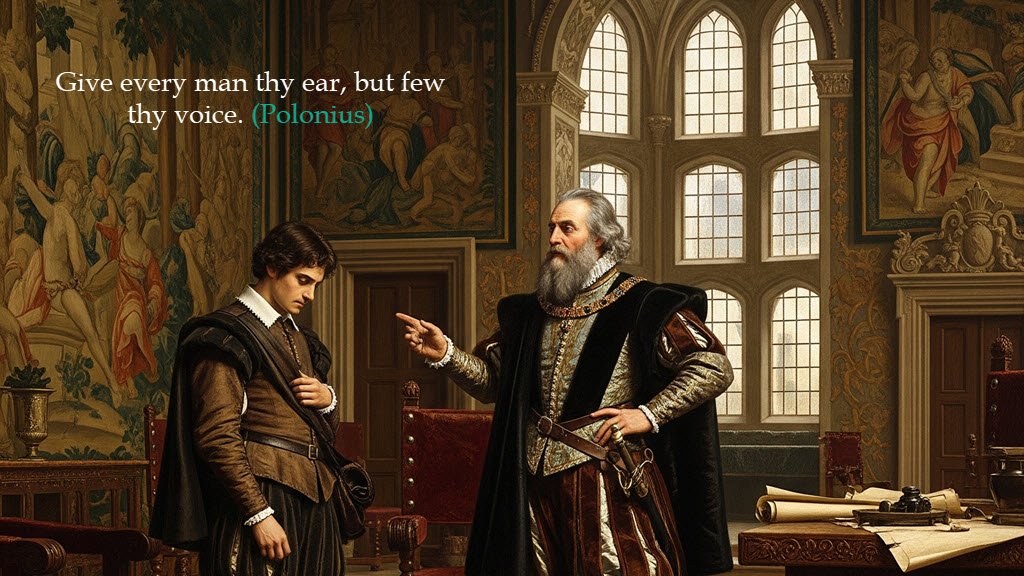
| Beware Of entrance to a quarrel; but being in, Bear’t that the opposed may beware of thee. Give every man thy ear, but few thy voice; Take each man’s censure, but reserve thy judgment. | Be careful not to get into a fight; but if you are in one, fight so well that your opponent will be afraid of you. Listen to everyone’s opinion, but share your thoughts with only a few. Listen to everyone’s criticism, but keep your own counsel. |
| Costly thy habit as thy purse can buy, But not express’d in fancy; rich, not gaudy; For the apparel oft proclaims the man, And they in France of the best rank and station Are of a most select and generous chief in that. | Wear clothes as expensive as you can afford, but don’t be showy. Be rich, not gaudy, because clothing often shows a person’s character, and in France, the best people are very particular about what they wear. |
| Neither a borrower nor a lender be; For loan oft loses both itself and friend, And borrowing dulls the edge of husbandry. | Neither lend nor borrow money. Lending often leads to losing both the money and a friend, and borrowing makes you lazy and careless with your finances. |
| This above all: to thine own self be true, And it must follow, as the night the day, Thou canst not then be false to any man. | Above all: be true to yourself. If you are, you can’t be false to anyone else, just as night must follow day. |
| Farewell. My blessing season this in thee! | Goodbye. May my blessing help this advice grow in you. |
| LAERTES: Most humbly do I take my leave, my lord. | I humbly take my leave, my lord. |
| POLONIUS: The time invites you; go. Your servants tend. | The time is right for you to go. Your servants are waiting. |
| LAERTES: Farewell, Ophelia; and remember well What I have said to you. | Farewell, Ophelia, and remember what I told you. |
| OPHELIA: ’Tis in my memory lock’d, And you yourself shall keep the key of it. | It’s locked in my memory, and you hold the key. |
| LAERTES: Farewell. | Farewell. |
| Exit LAERTES. | [Laertes exits.] |
| POLONIUS: What is’t, Ophelia, he hath said to you? | Ophelia, what did he say to you? |
| OPHELIA: So please you, something touching the Lord Hamlet. | He said something about Lord Hamlet. |
| POLONIUS: Marry, well bethought: ’Tis told me, he hath very oft of late Given private time to you; and you yourself Have of your audience been most free and bounteous: If it be so, as so ’tis put on me, And that in way of caution, I must tell you, You do not understand yourself so clearly As it behoves my daughter and your honour. | Ah, that’s good to know. I’ve been told that he has been spending a lot of private time with you, and that you have been very generous with your time. If this is true—and I’ve been told it is, as a warning—I must tell you that you are not behaving as is appropriate for my daughter and your reputation. |
| What is between you? give me up the truth. | What is going on between you two? Tell me the truth. |
| OPHELIA: He hath, my lord, of late made many tenders Of his affection to me. | He has, my lord, recently made many offers of affection to me. |
| POLONIUS: Tenders! Affection! Fie! what tenders? Do you think they are not of the nature of these? | “Tenders!” “Affection!” Nonsense! What kind of offers? You don’t think they’re real, do you? |
| OPHELIA: My lord, he hath importun’d me with love In honourable fashion. | My lord, he has been courting me honourably. |
| POLONIUS: Ay, fashion you may call it; go to, go to. | Yes, you can call it a “fashionable” thing to do. Go on, go on. |
| OPHELIA: And hath given countenance to his speech, my lord, With almost all the holy vows of heaven. | And he has supported his words with almost every holy vow there is. |
| POLONIUS: Ay, springes to catch woodcocks. I do know, When the blood burns, how prodigal the soul Lends the tongue vows: these blazes, daughter, Giving more light than heat, extinct in both, Even in their promise, as it is a-making, You must not take for fire. | Yes, those are traps to catch simpletons. I know that when passion is hot, a person’s tongue makes lavish vows. These are like quick, bright flashes of light, my daughter, that give more light than they do heat, and they die out as soon as they are made. You must not mistake them for true fire. |
| From this time, Be something scanter of your maiden presence; Set your entreatments at a higher rate Than a command to parley. | From now on, be a little more reserved. Make him work harder to see you. Don’t let him speak with you just because he asks. |
| For Lord Hamlet, Believe so much in him, that he is young, And with a larger tether may he walk Than may be given you: in few, Ophelia, Do not believe his vows; for they are brokers, Not of that dye which their investments show, But mere implorators of unholy suits, Breathing like sanctified and pious bawds, The better to beguile. | As for Lord Hamlet, believe this much: he is young and has more freedom than you do. In short, Ophelia, do not believe his vows, for they are like false promises, not what they seem to be. They are just trying to get you to do something dishonourable, pretending to be holy and righteous to deceive you. |
| This is for all: I would not, in plain terms, from this time forth, Have you so slander any moment leisure, As to give words or talk with the Lord Hamlet. Look to’t, I charge you: come your ways. | Here’s my final word: from now on, I don’t want you to waste a single moment of your free time speaking or talking with Lord Hamlet. Be careful, I command you. Now go. |
| OPHELIA: I shall obey, my lord. | I will obey, my lord. |
| Exeunt. | [They exit.] |
Introductory Notes
Act I, Scene 3 is a pivotal transition from the public world of the Danish court to the enclosed, private world of Polonius’s family. It sets the foundation for conflicts that will have far-reaching consequences, introducing characters whose rigid commitment to societal norms directly contributes to the unfolding tragedy. Polonius’s and Laertes’s counsel, though ostensibly well-meaning, is steeped in suspicion and manipulation, creating the conditions for Ophelia’s destruction. The themes of duty versus desire and appearance versus reality are clearly established, guiding the audience into the play’s central narrative. This resource provides students with a structured framework to interpret how this domestic scene fuels the tragic arc of the drama.
The Domestic Arena of Conflict
Following the public spectacle of the court and Hamlet’s private turmoil, Act I, Scene iii shifts focus entirely to the domestic world of Polonius’s family. This scene introduces a striking thematic contrast between the grand political stage of Elsinore and the intimate, yet equally fraught, sphere of familial duty and personal desire. Within the confines of Polonius’s chambers, a series of conversations defines the play’s secondary characters—Laertes, Ophelia, and Polonius—and establishes the emotional and moral traps that will ensnare both Hamlet and Ophelia.
The scene’s central action revolves around the giving of advice. Laertes offers cautionary words to his sister, Ophelia, about her relationship with Hamlet. This is followed by Polonius’s famously long-winded and seemingly contradictory precepts to Laertes, before he turns his paternal scrutiny and censure on Ophelia. The guidance from both men is steeped in cold pragmatism and an obsession with social reputation, in sharp contrast to the genuine, though volatile, emotions that drive Hamlet. Ophelia is portrayed as passive and obedient, caught between her feelings and the authority of her father and brother. Her final line, “I shall obey, my lord,” encapsulates her lack of agency and foreshadows the tragic consequences of her submission. This resource includes a detailed multiple-choice quiz and a comprehensive analysis to guide students through the complexities of this crucial scene, ensuring they grasp its implications for character development and the unfolding tragedy.
The Family Trinity: A Study in Patriarchal Control
Act I, Scene 3 serves as a microcosm of the patriarchal structure that governs the play’s world. The scene is dominated by the men of the family—Laertes and Polonius—who assert authority over the seemingly powerless Ophelia. Both present their advice as protective, yet it is grounded in a fundamental distrust of her judgment and a preoccupation with family reputation. Laertes’s warning—that Hamlet’s affection is a fleeting “fashion”—is less a brotherly concern than a political lecture on the constraints of Hamlet’s princely role. He explains that Hamlet “may not, as unvalued persons do, / Carve for himself,” as his choice of a wife must align with the “health of this whole state.” This underscores that Hamlet’s personal relationships are inherently political, a theme that permeates the play.
Polonius’s intervention is even more authoritarian. He dismisses Hamlet’s affection as “blazes, / Giving more light than heat” and calls his daughter a “green girl,” suggesting she lacks the discernment to distinguish genuine love from deceit. He reduces her honor to a commodity, urging her to “Set your entreatments at a higher rate” and referring to her virginity as “chaste treasure.” This commercial language, recurring throughout the play, implies that love and personal relationships are transactions to be managed for social gain. Ophelia’s simple response, “I shall obey, my lord,” emphasizes her lack of autonomy and signals her emotional and psychological vulnerability. Quiz questions about these interactions prompt students to examine the power dynamics and the systematic control of Ophelia.
Polonius’s Precepts: The Gap Between Appearance and Reality
Polonius’s well-known speech to Laertes is a critical moment in the scene’s character development. His “few precepts” offer practical advice on social behavior (“Be thou familiar, but by no means vulgar”) and fiscal restraint (“Neither a borrower nor a lender be”). The speech’s most famous line—“This above all: to thine own self be true”—appears to convey deep wisdom, yet within the broader context of his speech, which focuses on caution and social manipulation, it reads as inconsistent.
This contradiction is key to understanding Polonius. Far from being a wise moralist, he is a calculating figure whose counsel promotes surface-level virtue rather than genuine integrity. The gap between his purported values and his later actions—such as spying on his children and misreading Hamlet’s behavior—creates dramatic irony and underscores the theme of appearance versus reality. The quiz questions on Polonius’s speech challenge students to move beyond simple interpretation and assess the deeper complexities of his character.
The Foreshadowing of Family Conflict
In addition to character and theme, this scene introduces the central conflict that propels the tragedy. The warnings directed at Ophelia create an immediate obstacle in her relationship with Hamlet, forcing her to choose between personal desire and familial obedience. Laertes’s overbearing advice and Polonius’s demand that she avoid Hamlet are the first steps in a sequence that isolates her and contributes to her eventual mental collapse and death. The contrast between Hamlet’s introspective grief and Laertes’s impulsive desire for revenge will become a central comparative thread, transforming a domestic drama into a revenge tragedy. The quiz encourages students to explore how personal choices in this scene have lasting and devastating public consequences.
How well do you know the scene?
The following quiz is designed to ensure a total understanding of every plot element and significant detail within the scene. Each question has been carefully constructed to assess knowledge of character, plot, setting, and thematic foreshadowing, with a limit of three choices. Use blank piece of paper and write down your answers. Then, click on the next toggle down to see the answers.
1. Where does the scene take place?
A. A room in the castle, where Laertes and Ophelia are meeting secretly.
B. On the battlements, where Laertes is bidding farewell to the guards.
C. A room in Polonius’s house.
2. What is Laertes’s first line, indicating his readiness to travel?
A. “My necessaries are embarked. Farewell.”
B. “I shall not see you again.”
C. “The ship is waiting. We must go.”
3. What country is Laertes preparing to travel to?
A. England
B. France
C. Norway
4. What does Laertes advise Ophelia to be cautious of regarding Hamlet?
A. His true intentions in their relationship.
B. His mental state.
C. His loyalty to the King.
5. How does Laertes describe Hamlet’s love for Ophelia?
A. As a true and lasting affection.
B. As a “fashion and a toy in blood” that is “not permanent.”
C. As an honorable intention to marry her immediately.
6. Laertes warns Ophelia that Hamlet’s “will is not his own” because he is “subject to his birth.” What does this mean?
A. Hamlet is controlled by Claudius.
B. Hamlet’s choice of a wife is determined by the welfare of the state.
C. Hamlet has no willpower of his own.
7. How does Ophelia respond to Laertes’s advice?
A. She dismisses it as unnecessary.
B. She agrees to keep his lesson in her heart, but warns him not to be a hypocrite.
C. She promises to tell Hamlet about the conversation.
8. What does Ophelia accuse Laertes of doing, by saying he follows the “primrose path of dalliance”?
A. Being a reckless party-goer.
B. Giving her advice he does not follow himself.
C. Being a spendthrift with money.
9. When Polonius enters, what does he tell Laertes he is doing?
A. He says he is giving a “second leave” and that Laertes has been “stayed for.”
B. He says he is there to wish him a safe journey.
C. He says he is there to give him more money.
10. What is Polonius’s first piece of advice to Laertes?
A. To be familiar but by no means vulgar.
B. To be true to himself above all else.
C. To not give his “thoughts no tongue.”
11. Which of the following is NOT one of Polonius’s precepts to Laertes?
A. “Neither a borrower nor a lender be.”
B. “Give every man thy ear, but few thy voice.”
C. “Speak what you think, for it is always true.”
12. What famous precept does Polonius give that he says will make it so that Laertes “canst not then be false to any man”?
A. “To thine ownself be true.”
B. “The apparel oft proclaims the man.”
C. “Grapple them to thy soul with hoops of steel.”
13. What is Ophelia’s response to Laertes’s final warning?
A. She promises to “remember well” his advice, keeping the “key” to it.
B. She tells him that she will do as she pleases.
C. She says she will tell her father about what he has said.
14. After Laertes leaves, what does Polonius immediately question Ophelia about?
A. The advice Laertes gave her.
B. The gifts Hamlet has given her.
C. Her recent meetings with Hamlet.
15. How does Polonius describe Hamlet’s vows to Ophelia?
A. As “springes to catch woodcocks.”
B. As a sign of true and honest affection.
C. As an honorable path to marriage.
16. What does Polonius call Ophelia in his criticism of her naivety?
A. A “green girl.”
B. A “foolish child.”
C. A “troublesome daughter.”
17. What does Polonius command Ophelia to do about her relationship with Hamlet?
A. He orders her to be “somewhat scanter of your maiden presence” and not talk to him.
B. He tells her she can continue to see Hamlet, but only with his permission.
C. He tells her to write a letter to Hamlet breaking off the relationship.
18. What is Ophelia’s final response to her father’s commands?
A. She refuses to obey him.
B. She asks him to explain his reasoning more clearly.
C. She replies, “I shall obey, my lord.”
19. What does Polonius believe is a more valuable “tender” than Hamlet’s affections?
A. Her obedience to her father.
B. Her virginity, which she must “set… at a higher rate.”
C. Her public reputation.
20. What is the central purpose of this scene?
A. To show that Hamlet is the only character who feels true emotions.
B. To establish the characters of Laertes, Polonius, and Ophelia and their preoccupations with reputation and duty.
C. To reveal the true nature of Claudius’s plot.
Answers
- Where does the scene take place?
C. A room in Polonius’s house. - What is Laertes’s first line, indicating his readiness to travel?
A. “My necessaries are embarked. Farewell.” - What country is Laertes preparing to travel to?
B. France - What does Laertes advise Ophelia to be cautious of regarding Hamlet?
A. His true intentions in their relationship. - How does Laertes describe Hamlet’s love for Ophelia?
B. As a “fashion and a toy in blood” that is “not permanent.” - Laertes warns Ophelia that Hamlet’s “will is not his own” because he is “subject to his birth.” What does this mean?
B. Hamlet’s choice of a wife is determined by the welfare of the state. - How does Ophelia respond to Laertes’s advice?
B. She agrees to keep his lesson in her heart, but warns him not to be a hypocrite. - What does Ophelia accuse Laertes of doing, by saying he follows the “primrose path of dalliance”?
B. Giving her advice he does not follow himself. - When Polonius enters, what does he tell Laertes he is doing?
A. He says he is giving a “second leave” and that Laertes has been “stayed for.” - What is Polonius’s first piece of advice to Laertes?
C. To not give his “thoughts no tongue.” - Which of the following is NOT one of Polonius’s precepts to Laertes?
C. “Speak what you think, for it is always true.” - What famous precept does Polonius give that he says will make it so that Laertes “canst not then be false to any man”?
A. “To thine ownself be true.” - What is Ophelia’s response to Laertes’s final warning?
A. She promises to “remember well” his advice, keeping the “key” to it. - After Laertes leaves, what does Polonius immediately question Ophelia about?
C. Her recent meetings with Hamlet. - How does Polonius describe Hamlet’s vows to Ophelia?
A. As “springes to catch woodcocks.” - What does Polonius call Ophelia in his criticism of her naivety?
A. A “green girl.” - What does Polonius command Ophelia to do about her relationship with Hamlet?
A. He orders her to be “somewhat scanter of your maiden presence” and not talk to him. - What is Ophelia’s final response to her father’s commands?
C. She replies, “I shall obey, my lord.” - What does Polonius believe is a more valuable “tender” than Hamlet’s affections?
A. Her obedience to her father. - What is the central purpose of this scene?
B. To establish the characters of Laertes, Polonius, and Ophelia and their preoccupations with reputation and duty.