
The Troubled Prince
Contents
- Audio Version of the Scene
- Modern Text Version
- Introductory Notes
- Claudius and the Court: The Art of Manipulation
- Character and Perspective: The Voice of Reason
- Hamlet’s Introduction and First Soliloquy: The Price of Honesty
- The Horatio Revelation: From Doubt to Certainty
- How well do you know the scene?
- Answers
Audio Version of the Scene
Modern Text Version
Hamlet – Act 1, Scene 2 – Contradictions in the Court
A room of state in the castle.
| Original Text | Modern English |
|---|---|
| KING: Though yet of Hamlet our dear brother’s death The memory be green, and that it us befitted To bear our hearts in grief, and our whole kingdom To be contracted in one brow of woe; Yet so far hath discretion fought with nature That we with wisest sorrow think on him, Together with remembrance of ourselves. | Even though the memory of my dear brother Hamlet’s death is still fresh, and it was proper for us to mourn with heavy hearts, uniting the whole kingdom in sorrow, reason has guided us beyond grief. So while we still mourn wisely for him, we also must think about the needs of the present. |
| Therefore our sometime sister, now our queen, Th’imperial jointress to this warlike state, Have we, as ’twere with a defeated joy, With one auspicious and one dropping eye, With mirth in funeral, and with dirge in marriage, In equal scale weighing delight and dole, Taken to wife; | Therefore, our former sister-in-law, now our queen, the rightful partner to this strong kingdom, we have married. It is a strange mix of emotions—part joy, part sorrow—smiling in mourning, grieving at a wedding, balancing happiness with sadness. |
| nor have we herein barr’d Your better wisdoms, which have freely gone With this affair along. For all, our thanks. | And we did not do this without your advice—you have all agreed to it. For this, we thank you. |
| Now follows, that you know young Fortinbras, Holding a weak supposal of our worth, Or thinking by our late dear brother’s death Our state to be disjoint and out of frame, Colleagued with this dream of his advantage, He hath not fail’d to pester us with message, Importing the surrender of those lands Lost by his father, with all bonds of law, To our most valiant brother. | Now, as you know, young Fortinbras wrongly thinks we are weak, or that because of my brother’s recent death, Denmark is unstable. Believing this is his opportunity, he has been pestering us with demands to surrender the lands his father lost, which rightly belong to my brave brother. |
| So much for him. Now for ourself and for this time of meeting: Thus much the business is: we have here writ To Norway, uncle of young Fortinbras, Who, impotent and bed-rid, scarcely hears Of this his nephew’s purpose, to suppress His further gait herein; | So much for him. Now, about our own business: we have written to the King of Norway, young Fortinbras’ uncle, who is old and bedridden and hardly knows what his nephew is planning. We have asked him to stop Fortinbras from advancing further. |
| in that the levies, The lists, and full proportions are all made Out of his subject: and we here dispatch You, good Cornelius, and you, Voltemand, For bearers of this greeting to old Norway, Giving to you no further personal power To business with the King, more than the scope Of these dilated articles allow. Farewell; and let your haste commend your duty. | Since all Fortinbras’ forces are raised from Norway’s subjects, we are sending you, Cornelius and Voltemand, with this letter to old Norway. You are not to go beyond the instructions written here. Farewell, and carry out this duty quickly. |
| CORNELIUS and VOLTEMAND: In that, and all things, will we show our duty. | We will carry out this duty faithfully. |
| KING: We doubt it nothing: heartily farewell. | I have no doubt you will. Goodbye. |
| [Exeunt Voltemand and Cornelius.] | [Voltemand and Cornelius leave.] |
| And now, Laertes, what’s the news with you? You told us of some suit. What is’t, Laertes? You cannot speak of reason to the Dane, And lose your voice. What wouldst thou beg, Laertes, That shall not be my offer, not thy asking? The head is not more native to the heart, The hand more instrumental to the mouth, Than is the throne of Denmark to thy father. What wouldst thou have, Laertes? | And now, Laertes, what news do you bring? You said you had a request. What is it? You cannot ask something reasonable of the King of Denmark and be denied. Whatever you might request, I’ll likely offer it before you even ask. Denmark’s throne is as natural to your father as a head is to a heart, or a hand to a mouth. So, Laertes, what do you want? |
| LAERTES: Dread my lord, Your leave and favour to return to France, From whence though willingly I came to Denmark To show my duty in your coronation; Yet now I must confess, that duty done, My thoughts and wishes bend again toward France, And bow them to your gracious leave and pardon. | My lord, I would like your permission to return to France. I came here gladly to show respect at your coronation, but now that my duty is done, my thoughts and desires return to France. I ask for your leave and pardon. |
| KING: Have you your father’s leave? What says Polonius? | Do you have your father’s permission? What does Polonius say? |
| POLONIUS: He hath, my lord, wrung from me my slow leave By laboursome petition; and at last Upon his will I seal’d my hard consent. I do beseech you give him leave to go. | Yes, my lord. He worked hard to persuade me, and though reluctant, I finally gave my consent. I beg you, let him go. |
| KING: Take thy fair hour, Laertes; time be thine, And thy best graces spend it at thy will! | Go with my blessing, Laertes. Enjoy your freedom and spend your time as you wish! |
| But now, my cousin Hamlet, and my son— | And now, Hamlet, my nephew—and my son— |
| HAMLET: [Aside.] A little more than kin, and less than kind. | [Aside] Too closely related, but with little real affection. |
| KING: How is it that the clouds still hang on you? | Why do you still look so gloomy, Hamlet? |
| HAMLET: Not so, my lord, I am too much i’ the sun. | Not gloomy, my lord. Just tired of being so much in the spotlight—as your “son.” |
| QUEEN: Good Hamlet, cast thy nighted colour off, And let thine eye look like a friend on Denmark. Do not for ever with thy vailed lids Seek for thy noble father in the dust. Thou know’st ’tis common, all that lives must die, Passing through nature to eternity. | Dear Hamlet, stop wearing these dark clothes, and look kindly on Denmark. Don’t keep lowering your eyes as if searching for your father in the grave. You know that death is natural—everything living must die and move on to eternity. |
| HAMLET: Ay, madam, it is common. | Yes, mother, it’s common. |
| QUEEN: If it be, Why seems it so particular with thee? | If it’s common, why does it affect you so deeply? |
| HAMLET: Seems, madam! Nay, it is; I know not seems. ’Tis not alone my inky cloak, good mother, Nor customary suits of solemn black, Nor windy suspiration of forc’d breath, No, nor the fruitful river in the eye, Nor the dejected haviour of the visage, Together with all forms, moods, shows of grief, That can denote me truly. These indeed seem, For they are actions that a man might play; But I have that within which passeth show; These but the trappings and the suits of woe. | “Seems,” mother? No—it is. I don’t just look sad, I am sad. My black clothes, my sighs, my tears, my gloomy expression, all the signs of grief—these are just appearances, things people can fake. But inside me is grief that goes deeper than appearances. What you see is only the outside clothing of my sorrow. |
| KING: ’Tis sweet and commendable in your nature, Hamlet, To give these mourning duties to your father; But you must know, your father lost a father, That father lost, lost his, and the survivor bound In filial obligation, for some term To do obsequious sorrow. | It is good and noble of you, Hamlet, to show respect by mourning your father. But you must remember: your father also lost his father, and his father before him, and each survivor is expected to mourn for a time. |
| But to persevere In obstinate condolement is a course Of impious stubbornness. ’Tis unmanly grief, | But to continue in endless, stubborn grief is wrong—it shows defiance against heaven. Such grief is unmanly. |
| It shows a will most incorrect to heaven, A heart unfortified, a mind impatient, An understanding simple and unschool’d; | It shows a weak will that rebels against God, a heart without strength, an impatient mind, and a lack of wisdom. |
| For what we know must be, and is as common As any the most vulgar thing to sense, Why should we in our peevish opposition Take it to heart? | Since death is certain, as ordinary as anything in life, why fight against it so bitterly? |
| Fie, ’tis a fault to heaven, A fault against the dead, a fault to nature, To reason most absurd, whose common theme Is death of fathers, and who still hath cried, From the first corse till he that died today, ‘This must be so.’ | Shame on it—it’s an offence to heaven, an offence to the dead, and against nature. It’s unreasonable, since reason itself teaches that fathers die, and always have, from the first man to the man who died today. |
| We pray you throw to earth This unprevailing woe, and think of us As of a father; | So, I beg you, put aside this useless grief, and think of me as a father. |
| for let the world take note You are the most immediate to our throne, And with no less nobility of love Than that which dearest father bears his son Do I impart toward you. | Let the world know that you are next in line to the throne, and that I love you as much as any father loves a son. |
| For your intent In going back to school in Wittenberg, It is most retrograde to our desire: And we beseech you bend you to remain Here in the cheer and comfort of our eye, Our chiefest courtier, cousin, and our son. | As for your plan to return to school in Wittenberg, we do not want that. I beg you, stay here with us, where we can enjoy your company. You are our best friend, our family, and our son. |
| QUEEN: Let not thy mother lose her prayers, Hamlet. I pray thee stay with us; go not to Wittenberg. | Don’t refuse your mother’s request, Hamlet. Please stay with us, and don’t go back to Wittenberg. |
| HAMLET: I shall in all my best obey you, madam. | I’ll obey you, mother, as best I can. |
| KING: Why, ’tis a loving and a fair reply. Be as ourself in Denmark. Madam, come; This gentle and unforc’d accord of Hamlet Sits smiling to my heart; | That’s a kind and noble answer. Stay here and be one with us in Denmark. Madam, come—Hamlet’s willing agreement fills my heart with joy. |
| in grace whereof, No jocund health that Denmark drinks today But the great cannon to the clouds shall tell, And the King’s rouse the heaven shall bruit again, Re-speaking earthly thunder. Come away. | To celebrate this, every toast drunk in Denmark today will be echoed by cannon fire shaking the sky, making heaven resound with earthly thunder. Come, let’s go. |
| [Exeunt all but Hamlet.] | [Everyone exits, except Hamlet.] |
| HAMLET: O that this too too solid flesh would melt, Thaw, and resolve itself into a dew! | Oh, if only my body could just melt away, dissolve into nothing like mist! |
| Or that the Everlasting had not fix’d His canon ’gainst self-slaughter. O God! O God! | Or if only God hadn’t made a law against suicide. Oh God, oh God! |
| How weary, stale, flat, and unprofitable Seem to me all the uses of this world! | Everything in this world feels tired, empty, dull, and pointless to me! |
| Fie on’t! Oh fie! ’tis an unweeded garden That grows to seed; things rank and gross in nature Possess it merely. | Ugh! The world is like a neglected garden, overrun with weeds and disgusting things. |
| That it should come to this! But two months dead—nay, not so much, not two: | How has it come to this? My father has been dead not even two months—no, not even that! |
| So excellent a king; that was to this Hyperion to a satyr; | He was such a great king—compared to my uncle, he was like the sun-god compared to a goat. |
| so loving to my mother, That he might not beteem the winds of heaven Visit her face too roughly. | He loved my mother so much he wouldn’t even let the wind blow too harshly on her face. |
| Heaven and earth! Must I remember? | Heavens! Do I have to remember all this? |
| Why, she would hang on him As if increase of appetite had grown By what it fed on; | She clung to him, as though the more love she gave, the hungrier she became for more. |
| and yet, within a month— Let me not think on’t—Frailty, thy name is woman! | And yet, within a month—oh, I can hardly think about it—weakness, thy name is woman! |
| A little month, or ere those shoes were old With which she followed my poor father’s body Like Niobe, all tears.— | Barely a month—before the shoes she wore at my father’s funeral were even old—she, who cried like Niobe, weeping endlessly— |
| Why she, even she— O God! A beast that wants discourse of reason Would have mourn’d longer,— | She, even she—oh God!—even a beast without reason would have mourned longer! |
| married with mine uncle, My father’s brother; but no more like my father Than I to Hercules. | She married my uncle, my father’s brother—but he is nothing like my father, no more than I am like Hercules. |
| Within a month, Ere yet the salt of most unrighteous tears Had left the flushing in her galled eyes, She married. | Within a month—before her false tears had even dried from her red, swollen eyes—she married him. |
| O most wicked speed, to post With such dexterity to incestuous sheets! | Oh, what wicked haste, rushing so quickly into a sinful, incestuous marriage bed! |
| It is not, nor it cannot come to good. | This cannot possibly end well. |
| But break, my heart, for I must hold my tongue. | But my heart must break in silence, for I cannot speak of it. |
| Enter Horatio, Marcellus and Barnardo. | [Horatio, Marcellus, and Barnardo enter.] |
| HORATIO: Hail to your lordship! | Greetings, my lord! |
| HAMLET: I am glad to see you well: Horatio, or I do forget myself. | I’m glad to see you. Horatio—is that you, or am I mistaken? |
| HORATIO: The same, my lord, And your poor servant ever. | Yes, my lord, it’s me—your humble servant, always. |
| HAMLET: Sir, my good friend; I’ll change that name with you: And what make you from Wittenberg, Horatio?—Marcellus? | No, you’re my good friend, not my servant—I insist. But what brings you here from Wittenberg, Horatio? And Marcellus, is that you? |
| MARCELLUS: My good lord. | Yes, my lord. |
| HAMLET: I am very glad to see you.—Good even, sir.—But what, in faith, make you from Wittenberg? | I’m so glad to see you both.—Good evening, sir.—But seriously, Horatio, what brings you here from Wittenberg? |
| HORATIO: A truant disposition, good my lord. | Honestly, a bit of truancy, my lord. |
| HAMLET: I would not hear your enemy say so; Nor shall you do my ear that violence, To make it truster of your own report Against yourself. I know you are no truant. | I wouldn’t let your enemy call you a slacker, Horatio—and I won’t let you insult yourself either. I know you’re no shirker. |
| But what is your affair in Elsinore? We’ll teach you to drink deep ere you depart. | So what brings you to Elsinore? Before you leave, we’ll teach you to drink like a true Dane. |
| HORATIO: My lord, I came to see your father’s funeral. | I came, my lord, for your father’s funeral. |
| HAMLET: I prithee do not mock me, fellow-student. I think it was to see my mother’s wedding. | Please, don’t mock me, my friend. I think you really came for my mother’s wedding. |
| HORATIO: Indeed, my lord, it follow’d hard upon. | True, my lord—it happened so soon after. |
| HAMLET: Thrift, thrift, Horatio! The funeral bak’d meats Did coldly furnish forth the marriage tables. | Economy, Horatio! The food from the funeral feast was coldly served again at the wedding banquet. |
| Would I had met my dearest foe in heaven Or ever I had seen that day, Horatio. | I wish I’d met my worst enemy in heaven before I had to see that day. |
| My father,—methinks I see my father. | My father—I think I see him now. |
| HORATIO: Where, my lord? | Where, my lord? |
| HAMLET: In my mind’s eye, Horatio. | In my imagination, Horatio. |
| HORATIO: I saw him once; he was a goodly king. | I saw him once—he was a noble king. |
| HAMLET: He was a man, take him for all in all, I shall not look upon his like again. | He was a man—in every way complete. I’ll never see his equal again. |
| HORATIO: My lord, I think I saw him yesternight. | My lord, I believe I saw him last night. |
| HAMLET: Saw? Who? | Saw? Who did you see? |
| HORATIO: My lord, the King your father. | My lord, your father, the King. |
| HAMLET: The King my father! | My father, the King?! |
| HORATIO: Season your admiration for a while With an attent ear, till I may deliver Upon the witness of these gentlemen This marvel to you. | Control your shock for a moment, and listen carefully, while these gentlemen and I tell you this amazing story. |
| HAMLET: For God’s love let me hear. | For God’s sake, tell me! |
| HORATIO: Two nights together had these gentlemen, Marcellus and Barnardo, on their watch In the dead waste and middle of the night, Been thus encounter’d. A figure like your father, Armed at point exactly, cap-à-pie, Appears before them, and with solemn march Goes slow and stately by them: thrice he walk’d By their oppress’d and fear-surprised eyes, Within his truncheon’s length; | For two nights in a row, these men, Marcellus and Barnardo, while on watch in the middle of the night, were met by a figure that looked exactly like your father, fully armed from head to toe. It walked by them with a slow, solemn march—three times it passed them, close enough to touch. |
| whilst they, distill’d Almost to jelly with the act of fear, Stand dumb, and speak not to him. | They were frozen with fear, almost turned to jelly, unable to speak to it. |
| This to me In dreadful secrecy impart they did, And I with them the third night kept the watch, Where, as they had deliver’d, both in time, Form of the thing, each word made true and good, The apparition comes. | They told me about it in strict secrecy, and on the third night, I joined them on the watch. Just as they described—same time, same appearance—the ghost appeared. |
| I knew your father; These hands are not more like. | I knew your father—and the ghost looked exactly like him, as clearly as my own hands resemble each other. |
| HAMLET: But where was this? | Where did this happen? |
| MARCELLUS: My lord, upon the platform where we watch. | My lord, on the battlements, where we keep guard. |
| HAMLET: Did you not speak to it? | Did you speak to it? |
| HORATIO: My lord, I did; But answer made it none: yet once methought It lifted up it head, and did address Itself to motion, like as it would speak. | Yes, my lord, I spoke to it. But it gave no answer. Once, I thought it lifted its head, as if preparing to speak. |
| But even then the morning cock crew loud, And at the sound it shrunk in haste away, And vanish’d from our sight. | But just then, the cock crowed loudly, and at the sound, it shrank back in a hurry and disappeared from sight. |
| HAMLET: ’Tis very strange. | That is very strange. |
| HORATIO: As I do live, my honour’d lord, ’tis true; And we did think it writ down in our duty To let you know of it. | As I live, my lord, it is true. We thought it our duty to tell you. |
| HAMLET: Indeed, indeed, sirs, but this troubles me. Hold you the watch tonight? | Truly, my friends, this disturbs me. Will you stand guard again tonight? |
| MARCELLUS and BARNARDO: We do, my lord. | Yes, my lord, we will. |
| HAMLET: Arm’d, say you? | You say he was armed? |
| Both: Arm’d, my lord. | Armed, my lord. |
| HAMLET: From top to toe? | From head to toe? |
| BOTH: My lord, from head to foot. | From head to foot, my lord. |
| HAMLET: Then saw you not his face? | Then you couldn’t see his face? |
| HORATIO: O yes, my lord, he wore his beaver up. | Oh yes, my lord, he had his visor raised. |
| HAMLET: What, look’d he frowningly? | And did he look angry? |
| HORATIO: A countenance more in sorrow than in anger. | His face looked more sad than angry. |
| HAMLET: Pale, or red? | Was he pale, or red-faced? |
| HORATIO: Nay, very pale. | Very pale. |
| HAMLET: And fix’d his eyes upon you? | And he stared at you? |
| HORATIO: Most constantly. | Very steadily. |
| HAMLET: I would I had been there. | I wish I had been there. |
| HORATIO: It would have much amaz’d you. | It would have amazed you greatly. |
| HAMLET: Very like, very like. Stay’d it long? | No doubt, no doubt. Did it stay long? |
| HORATIO: While one with moderate haste might tell a hundred. | Long enough to count to a hundred at a steady pace. |
| MARCELLUS and BARNARDO: Longer, longer. | Longer than that! |
| HORATIO: Not when I saw’t. | Not when I saw it. |
| HAMLET: His beard was grizzled, no? | His beard was streaked with grey, wasn’t it? |
| HORATIO: It was, as I have seen it in his life, A sable silver’d. | Yes, as I remember from his life—black, streaked with silver. |
| HAMLET: I will watch tonight; Perchance ’twill walk again. | I will stand guard tonight; perhaps it will appear again. |
| HORATIO: I warrant you it will. | I’m sure it will. |
| HAMLET: If it assume my noble father’s person, I’ll speak to it, though hell itself should gape And bid me hold my peace. | If it appears looking like my father, I will speak to it—even if hell itself opens and tells me to stay silent. |
| I pray you all, If you have hitherto conceal’d this sight, Let it be tenable in your silence still; | I beg you, if you have kept this secret until now, keep it secret still. |
| And whatsoever else shall hap tonight, Give it an understanding, but no tongue. | Whatever happens tonight, observe it, but speak nothing of it. |
| I will requite your loves. So, fare ye well. | I will repay your loyalty. Now, farewell. |
| Upon the platform ’twixt eleven and twelve, I’ll visit you. | I’ll join you on the platform between eleven and twelve tonight. |
| ALL: Our duty to your honour. | We are at your service, my lord. |
| HAMLET: Your loves, as mine to you: farewell. | Your friendship, as mine to you. Farewell. |
| [Exeunt Horatio, Marcellus and Barnardo.] | [Horatio, Marcellus, and Barnardo exit.] |
| HAMLET: My father’s spirit in arms! All is not well; I doubt some foul play: would the night were come! Till then sit still, my soul: foul deeds will rise, Though all the earth o’erwhelm them, to men’s eyes. | My father’s ghost, dressed for war! Something is wrong—I fear foul play. If only night would come quickly! Until then, my soul must wait. Evil deeds will come to light, no matter how much the earth tries to bury them. |
| [Exit.] | [Hamlet exits.] |
Introductory Notes
Following the ominous, supernatural opening of the play, Act I, Scene ii shifts the audience into the bustling yet deeply unsettling world of the Danish court. The scene sharply contrasts the foreboding darkness of the battlements with the seemingly jovial atmosphere inside Elsinore Castle. This is not a setting for quiet reflection but one of public spectacle and political maneuvering, as the new king, Claudius, delivers his inaugural address to the kingdom.
Claudius’s speech is a calculated display of rhetorical control. He seeks to project stability and balance by mourning his brother’s death while simultaneously celebrating his own marriage to Queen Gertrude. He proclaims a fragile equilibrium: “With mirth in funeral and with dirge in marriage, / In equal scale weighing delight and dole.” However, his language is marked by contradiction, hinting at the corruption beneath the court’s cheerful surface. This scene introduces the central conflict of the play: the public image of a thriving state versus the private reality of a kingdom that is “disjoint and out of frame.”
Beyond the political tensions and emotional undercurrents, the scene introduces the central characters who will drive the narrative forward. Claudius emerges as a cunning and deeply guarded antagonist. Queen Gertrude, Hamlet’s mother, appears conflicted and emotionally compromised. Most significantly, we meet Prince Hamlet, the only character unwilling to partake in the court’s performance. His “unmanly grief” stands in stark contrast to the enforced cheerfulness around him and reveals the depth of his inner turmoil. The scene culminates in Hamlet’s first soliloquy—a searing reflection on his despair and disillusionment with a world he describes as an “unweeded garden.” It is here that the play’s core themes of revenge and madness begin to take root, as Horatio, Marcellus, and Bernardo arrive to inform Hamlet of the Ghost’s appearance.
Claudius and the Court: The Art of Manipulation
The transition from the bleak battlements to the lavish royal court is both abrupt and deliberate. Claudius, in his opening speech, aims to present an image of confidence, stability, and unity. He frames his swift marriage as a practical act of governance, a necessary measure to “weigh delight and dole” during a time of national mourning. Yet, the language he employs—laden with oxymorons and contradictions such as “defeated joy” and “with an auspicious and a dropping eye”—reveals the unnaturalness of his actions. His cheerful demeanor is a calculated attempt to maintain the illusion of normalcy. Claudius’s speech, along with his interactions with Laertes and Hamlet, portrays him as a persuasive speaker who uses public performance to obscure his moral failings. The accompanying quiz questions focus on his rhetoric and behavior, challenging students to look beyond his words and uncover the underlying deceit and corruption.
Character and Perspective: The Voice of Reason
Horatio’s role in this scene is pivotal and goes far beyond that of a mere witness. Introduced as a “scholar” and a “voice of Reason,” he is brought to the battlements to prove the guards’ story to be “but our fantasy”. His initial skepticism, encapsulated in his line “Tush, tush, ’twill not appear” , is a deliberate literary device.
Shakespeare faced a significant dramatic challenge: how to make a ghost story believable to a Renaissance audience with a wide range of beliefs regarding the supernatural. By introducing a rational, educated character who initially doubts the supernatural event, Shakespeare validates the Ghost’s reality for the audience. Horatio functions as a surrogate for the audience’s own skepticism. When he sees the Ghost, his reaction is not one of casual acceptance but of overwhelming terror and conviction. He confesses, “I would not have believed it without the witness of my own eyes”. This statement moves the scene from the realm of simple superstition into a profound exploration of truth and reality, lending dramatic legitimacy to the entire plot that will hinge on the Ghost’s testimony. Questions on Horatio’s initial attitude and his subsequent reaction are intended to assess a student’s understanding of his crucial role in establishing the play’s credibility.
Hamlet’s Introduction and First Soliloquy: The Price of Honesty
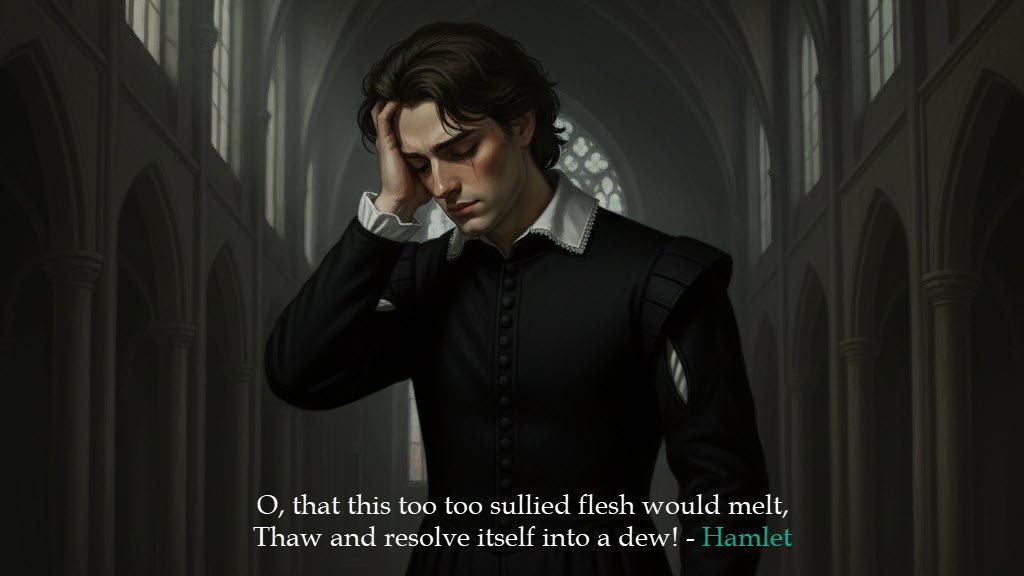
Hamlet’s entrance is a striking contrast to the court’s festive appearance. While others wear celebratory clothing, he remains in “inky cloaks,” a visible expression of his grief. When Queen Gertrude urges him to move past his mourning, Hamlet firmly rejects the court’s superficiality. He asserts that his sorrow is not a performance but a genuine emotional state that “passes show.” This response immediately marks him as a figure of sincerity in a setting dominated by pretense.
His first soliloquy offers a window into his internal conflict. He is devastated by his mother’s quick remarriage, which he sees as a betrayal of her love for his father. He likens the world to an “unweeded garden,” overrun with moral decay where “things rank and gross in nature” prevail. His contemplation of suicide underscores the intensity of his despair—a theme that remains central throughout the play. This soliloquy is essential to understanding Hamlet’s character; his anguish stems not only from personal loss but from a deep disenchantment with humanity. The related quiz questions prompt students to explore the psychological complexity of Hamlet’s character and his confrontation with the court’s duplicity.
The Horatio Revelation: From Doubt to Certainty
The final section of the scene introduces a key turning point, as Horatio and the guards recount the appearance of the Ghost. Horatio, the rational observer from Act I, Scene i, describes the encounter in precise and credible detail, noting the Ghost was “arm’d… from top to toe.” Hamlet’s immediate belief in their account is revealing—he shows no hesitation. His grief swiftly turns to suspicion as he declares, “I doubt some foul play.” This moment initiates the revenge narrative. Hamlet’s internal anguish is now linked to a defined external cause. The Ghost’s appearance shifts his sorrow into a moral obligation, setting the course for the action to follow. The quiz questions on this part encourage students to examine how the scene bridges Hamlet’s introspective grief with the broader plot of vengeance.
How well do you know the scene?
The following quiz is designed to ensure a total understanding of every plot element and significant detail within the scene. Each question has been carefully constructed to assess knowledge of character, plot, setting, and thematic foreshadowing, with a limit of three choices. Use blank piece of paper and write down your answers. Then, click on the next toggle down to see the answers.
1. How does Claudius describe his marriage to Gertrude in his opening speech?
A. A loving union that fills the entire kingdom with joy.
B. A necessary political alliance for the sake of the state.
C. A balance of “mirth in funeral” and “dirge in marriage.”
2. What is Claudius’s stated purpose for writing to the “impotent and bedrid” King of Norway?
A. To warn him that Hamlet is plotting an attack.
B. To ask him to rein in his nephew, young Fortinbras.
C. To formally announce his marriage to Gertrude.
3. What reason does Laertes give for wanting to return to France?
A. He is homesick and wishes to leave the tense atmosphere of Elsinore.
B. He has been given leave by his father, Polonius, after “laborsome petition.”
C. He is concerned about the new king’s reign and wants to be away from the court.
4. How does Claudius address Hamlet in his public speech to the court?
A. He criticizes his “unmanly grief” and calls him his “son.”
B. He expresses his approval of Hamlet’s continued mourning for his father.
C. He dismisses him entirely, focusing only on Laertes and the political situation.
5. What is Hamlet’s response to his mother’s plea for him to stop wearing black clothes?
A. He agrees to change his clothes and his behavior.
B. He states that his outward appearance is a superficial display that cannot capture his true inner sorrow.
C. He says he will obey her, but only if he is allowed to return to Wittenberg.
6. What does Claudius call Hamlet’s continued mourning for his father?
A. A “sweet and commendable” expression of love.
B. An “unmanly grief” and “obstinate condolement.”
C. A personal insult to the new King.
7. Why does Claudius and Gertrude want Hamlet to remain at Elsinore instead of returning to Wittenberg?
A. They fear he will incite rebellion among the university students.
B. They want to keep him close and under their “eye.”
C. They believe he needs more time to mourn his father.
8. What is the central theme of Hamlet’s first soliloquy?
A. His anger at Claudius for stealing the throne.
B. His disgust at the corruption of the world and his mother’s hasty marriage.
C. His sadness over the loss of his father.
9. What does Hamlet say would have mourned longer than his mother did for his father?
A. Laertes
B. A ghost
C. A beast without the power of reason
10. How does Hamlet describe his deceased father in the soliloquy?
A. A “Hyperion to a satyr,” far superior to Claudius.
B. A good man, but a weak king.
C. A father he hardly knew.
11. Who is the last person to enter the scene before Hamlet’s first soliloquy?
A. Polonius
B. Horatio
C. Rosencrantz and Guildenstern
12. When Horatio and the guards approach Hamlet, they report that they have seen what?
A. A ghost that looks like his father, dressed in armor.
B. A ghost that has been haunting the castle since the King’s death.
C. A ghost that appeared to them in the dead of the night.
13. What is Hamlet’s reaction to the news from Horatio and the guards?
A. He is terrified and immediately believes them.
B. He is skeptical and laughs at the idea of a ghost.
C. He is shocked and immediately suspects “foul play.”
14. When Horatio tells Hamlet the Ghost was “arm’d” what detail does he provide that confirms Hamlet’s suspicions?
A. He was wearing the same helmet as the late king.
B. He was armed from “top to toe.”
C. He was brandishing a sword.
15. What does Hamlet say he will do if the Ghost appears?
A. He will hide and wait for it to pass.
B. He will speak to it “though hell itself should gape.”
C. He will run back to the court and tell Claudius.
16. Where do Hamlet and his companions agree to meet?
A. On the castle battlements.
B. In the royal library.
C. In the great hall.
17. What is Hamlet’s final line of the scene?
A. “The time is out of joint. O cursed spite / That ever I was born to set it right!”
B. “My father’s spirit in arms! All is not well. / I doubt some foul play.”
C. “The rest is silence.”
18. Horatio’s detailed account of the Ghost’s appearance and the guards’ sightings serves what purpose?
A. To convince Hamlet that the Ghost is real.
B. To set up the next scene where the Ghost will reveal the truth.
C. To demonstrate Horatio’s knowledge of military armor.
19. What is Claudius’s last action in the scene before Hamlet’s soliloquy?
A. He orders Hamlet to be watched by Polonius.
B. He announces that Hamlet’s “unforced accord” to stay in Denmark will be celebrated with cannons.
C. He orders all the courtiers to leave immediately.
20) In Hamlet’s soliloquy (“O, that this too too solid flesh would melt…”), what is the main theme he expresses?
A) His excitement about inheriting the throne of Denmark
B) His grief and disgust over his mother’s hasty marriage to Claudius
C) His determination to avenge his father’s death immediately
Answers
Hamlet Quiz: Act 1, Scene 2
- How does Claudius describe his marriage to Gertrude in his opening speech?
- C. A balance of “mirth in funeral” and “dirge in marriage.”
- What is Claudius’s stated purpose for writing to the “impotent and bedrid” King of Norway?
- B. To ask him to rein in his nephew, young Fortinbras.
- What reason does Laertes give for wanting to return to France?
- B. He has been given leave by his father, Polonius, after “laborsome petition.”
- How does Claudius address Hamlet in his public speech to the court?
- A. He criticizes his “unmanly grief” and calls him his “son.”
- What is Hamlet’s response to his mother’s plea for him to stop wearing black clothes?
- B. He states that his outward appearance is a superficial display that cannot capture his true inner sorrow.
- What does Claudius call Hamlet’s continued mourning for his father?
- B. An “unmanly grief” and “obstinate condolement.”
- Why do Claudius and Gertrude want Hamlet to remain at Elsinore instead of returning to Wittenberg?
- B. They want to keep him close and under their “eye.”
- What is the central theme of Hamlet’s first soliloquy?
- B. His disgust at the corruption of the world and his mother’s hasty marriage.
- What does Hamlet say would have mourned longer than his mother did for his father?
- C. A beast without the power of reason
- How does Hamlet describe his deceased father in the soliloquy?
- A. A “Hyperion to a satyr,” far superior to Claudius.
- Who is the last person to enter the scene before Hamlet’s first soliloquy?
- B. Horatio
- When Horatio and the guards approach Hamlet, they report that they have seen what?
- A. A ghost that looks like his father, dressed in armor.
- What is Hamlet’s reaction to the news from Horatio and the guards?
- C. He is shocked and immediately suspects “foul play.”
- When Horatio tells Hamlet the Ghost was “arm’d” what detail does he provide that confirms Hamlet’s suspicions?
- B. He was armed from “top to toe.”
- What does Hamlet say he will do if the Ghost appears?
- B. He will speak to it “though hell itself should gape.”
- Where do Hamlet and his companions agree to meet?
- A. On the castle battlements.
- What is Hamlet’s final line of the scene?
- B. “My father’s spirit in arms! All is not well. / I doubt some foul play.”
- Horatio’s detailed account of the Ghost’s appearance and the guards’ sightings serves what purpose?
- A. To convince Hamlet that the Ghost is real.
- What is Claudius’s last action in the scene before Hamlet’s soliloquy?
- B. He announces that Hamlet’s “unforced accord” to stay in Denmark will be celebrated with cannons.
- In Hamlet’s soliloquy (“O, that this too too solid flesh would melt…”), what is the main theme he expresses?
- B. His grief and disgust over his mother’s hasty marriage to Claudius
Contents
- Audio Version of the Scene
- Modern Text Version
- Introductory Notes
- Claudius and the Court: The Art of Manipulation
- Character and Perspective: The Voice of Reason
- Hamlet’s Introduction and First Soliloquy: The Price of Honesty
- The Horatio Revelation: From Doubt to Certainty
- How well do you know the scene?
- Answers